
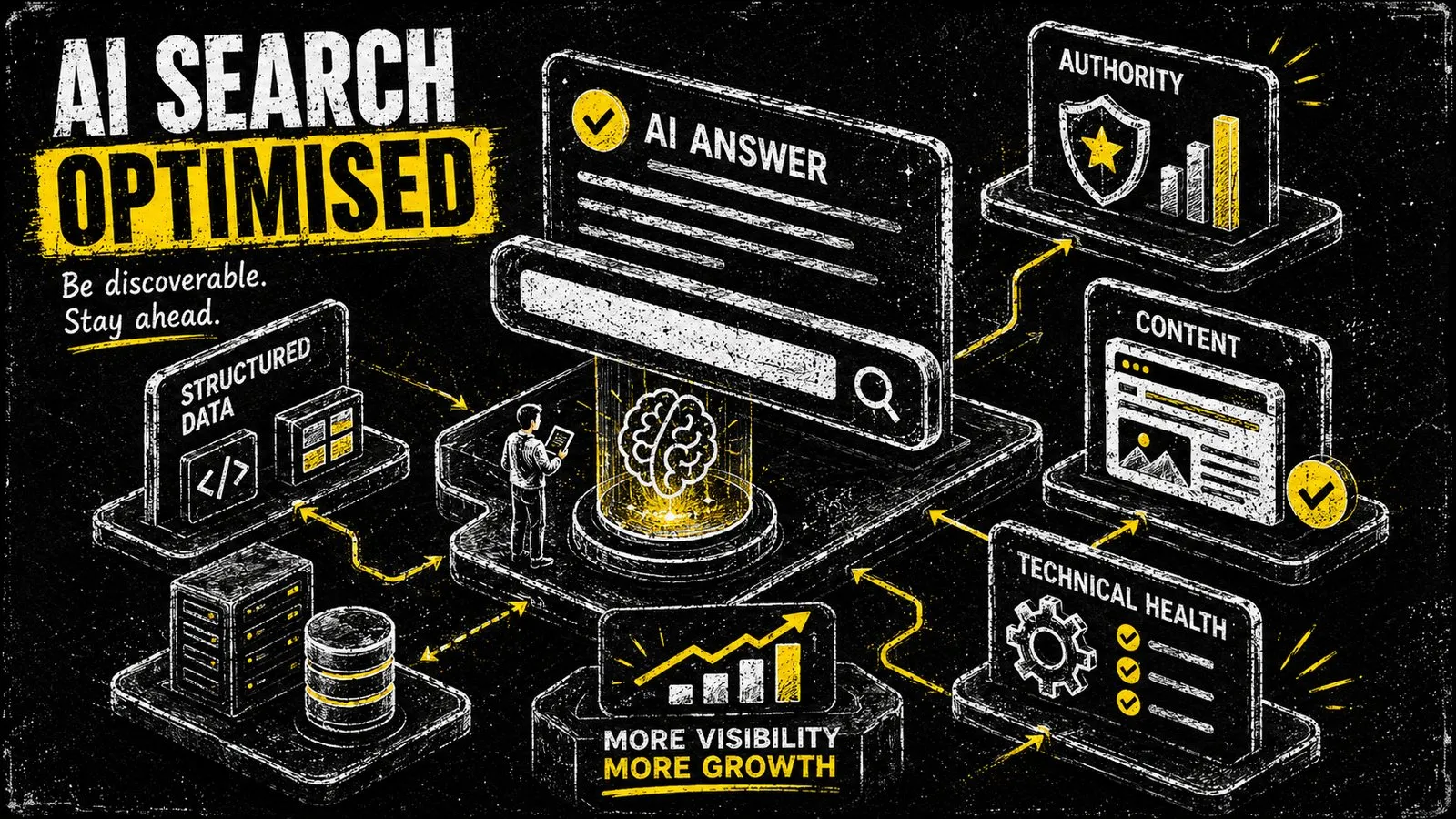
If you want to know how to optimise your business for AI-powered search results, the answer starts with structure, not strategy. The businesses appearing in AI-generated summaries and conversational search answers right now are not always the most established in their sector. They are the ones whose content is structured so AI systems can read, extract, and confidently attribute it. We see this pattern constantly across the AEO and GEO work we do at Codebreak. A service business with a well-built content architecture and consistent web presence will consistently outperform a larger competitor whose website is technically sound but built purely for human readers.
The question most owners are asking is direct: "Why does my competitor appear in these AI answers and I do not?" The difference is often structural rather than competitive, though content quality and relevance remain important factors. This 8-step framework addresses exactly that. Work through it systematically and you build a meaningful advantage in generative search visibility while most of the market is still catching up.
Why AI search surfaces different winners than traditional search
Traditional search returns a ranked list of pages and lets the user decide which to click. AI-powered search, including Google's AI Overviews, Perplexity, and conversational engines like ChatGPT, works differently. It synthesises a direct answer and attributes that answer to sources it can verify, extract from cleanly, and corroborate across multiple web locations. A page that ranks well in organic search may not appear in an AI answer at all if the content is not structured for extraction.
It is worth noting that Google is clear on one point: there is no special AI SEO shortcut. The same core content quality principles that underpin traditional search performance remain the foundation. What changes is the emphasis on extractability and entity clarity.
How AI systems decide which businesses to include
AI systems build a candidate pool by drawing from multiple source types: your website, your Google Business Profile, review platforms, directories, and editorial coverage. They then cross-reference that pool for consistency and corroboration. A business whose information is coherent and consistent across all of these sources gives the AI system enough confidence to surface it in an answer. Conflicting or incomplete information across sources reduces that confidence significantly.
What this means for a service business owner
The practical implication is this: businesses with clear entity data, well-structured pages, and a consistent presence across trusted sources hold a structural advantage in generative search visibility. This is not about gaming an algorithm. It is about making your business legible to systems that are synthesising answers at scale. The 8 steps below address each of the key signals those systems look for.
How to optimise your business for AI-powered search results: Steps 1, 2
Before any technical implementation, the content itself has to work as a source. AI systems favour pages that answer questions directly and demonstrate depth across a specific subject area. These two steps form the content foundation everything else builds on.
Step 1: Write answer-first content with extractable structure
Based on current AI Overview behaviour, the most frequently cited formats are Q&A pages, concise definition blocks, numbered lists, and how-to guides. The reason is straightforward enough: these formats are self-contained and directly answer a query without requiring interpretation. Start each section with a direct answer or clear definition in the opening one or two sentences. Use descriptive H2 and H3 headings that mirror how your clients actually ask questions. Structure content in discrete, modular sections so an AI system can quote one section without needing the rest of the page for context.
Plain narrative tends to be cited less often than modular, answer-first formats in AI Overviews. Continuous prose requires interpretation, and AI systems prefer content they can lift cleanly. Rewrite your key service pages and resource guides with this structure in mind and the extractability of your content improves immediately.
Step 2: Build topical authority through depth, not volume
AI systems favour sites that cover a subject comprehensively over sites that publish broadly but shallowly. A pillar-and-cluster architecture addresses this directly: one comprehensive pillar page on a core topic, supported by a set of cluster pages that go deep on specific aspects of that topic. A home services business, for example, benefits far more from a thorough pillar on boiler servicing supported by detailed cluster pages on each related service than from fifty thin posts across unconnected topics. Depth signals authority to AI systems in a way that volume alone does not, and a smaller set of genuinely thorough pages consistently outperforms a large library of superficial content for generative search visibility.
Steps 3, 4: Add structured data so AI can read your business clearly
Structured data does not guarantee AI visibility, but it is one of the clearest signals a service business can send when optimising for AI-powered search results. It removes ambiguity about who you are, what you do, and where you operate, which is exactly what AI systems need to include a business confidently in a generated answer. Adding one additional layer of context here: schema works alongside content quality, not as a replacement for it. Strong structured data on a thin page will not carry you far.
Step 3: Choose the schema types that matter for service businesses
For a UK service business in 2026, the priority schema stack looks like this:
- LocalBusiness (or a specific subtype such as Dentist, Plumber, or LegalService) with name, address, areaServed, and sameAs properties on your homepage and location pages
- Service on each individual service page, including serviceType, provider, areaServed, and hasOfferCatalog where relevant
- Organization with name, URL, logo, and sameAs to reinforce brand entity signals across the site
- AggregateRating only where genuine, displayed reviews exist on the page
- BreadcrumbList to clarify page hierarchy for both traditional and AI search
The goal is entity clarity. AI systems need to understand without ambiguity who your business is, what it offers, and where it operates. Schema delivers that in a machine-readable format that does not depend on the AI system parsing your prose correctly.
Step 4: Mark up FAQs and how-to content for AI summaries
FAQPage schema maps directly to how AI systems retrieve question-and-answer pairs. Each Question and acceptedAnswer pair becomes a discrete unit an AI can surface independently. Prioritise FAQPage markup on your service pages and resource guides, particularly pages that address the questions your clients ask most frequently before making an enquiry.
HowTo schema lets AI pull individual steps into an overview without needing to process the surrounding content. Add HowTo markup to any procedural content, step-by-step guides, or process explanations across the site. These two schema types have the most direct relationship to how AI Overviews retrieve and display service business content.
Steps 5, 6: Build the citation footprint AI systems look for
AI systems for local and service queries verify business information by cross-referencing multiple sources. Your Google Business Profile, review platforms, directories, and your own website all feed into that verification process. Steps 5 and 6 address the corroboration signals that build AI confidence in surfacing your business.
Step 5: Optimise your Google Business Profile for local AI queries
Your Google Business Profile is the single highest-impact listing for local AI search visibility. Complete every available field: primary category and subcategories, service area, hours, phone number, website, and services list. Use localised wording in your description that reflects how your clients actually search for what you offer. Fresh reviews with substantive content and recent activity on the profile both increase the likelihood of AI mention for local queries. A thin or outdated profile leaves AI systems with too little reliable data to work with, and they will default to a competitor whose profile is complete.
Step 6: Create consistent citations across trusted directories
For UK service businesses, the core citation platforms that feed AI corroboration include Yell, Bing Places, Apple Business Connect, Trustpilot, Checkatrade, FreeIndex, and Facebook Business Pages. Sector-specific directories and chamber of commerce listings add further corroboration for professional and trade businesses. The critical variable across all of these is NAP consistency: your name, address, and phone number must be identical across every platform. Inconsistent information actively reduces AI confidence in surfacing your business. Audit every live citation and correct any discrepancies before building new ones.
Steps 7, 8: Format your pages and track what is working
The final two steps address execution quality and measurement. Knowing what to do is only useful if the implementation is right and you can see whether it is working.
Step 7: Structure pages so AI can quote your content directly
AI Overviews favour modular, answer-ready content over narrative long-form. In practice, this means short paragraphs with one clear idea each, numbered steps for procedural content, concise definition blocks early in each section, and descriptive subheadings that mirror question intent. Each paragraph should be able to stand alone as a meaningful answer to a specific question.
If a section of your page requires reading the preceding three paragraphs to make sense, it is not structured for AI-powered search optimisation. Review your highest-traffic service pages against this standard and restructure any sections that read as continuous narrative rather than discrete answers.
Step 8: Measure AI impressions, citations and assisted conversions
Tracking AI visibility requires a combination of tools rather than a single platform. Google Search Console provides the starting point: use the Performance report to track impressions, queries, and page-level coverage, filtering for AI Overviews where that search type is available in your account. For citation tracking across AI platforms including ChatGPT, Perplexity, and Gemini, tools such as Semrush AI Visibility and Ahrefs allow you to monitor how frequently your domain is cited in AI-generated responses. In GA4, segment AI referral traffic and use path exploration to identify assisted conversions where AI exposure appeared earlier in the journey. The key metrics to track are citation frequency, branded search lift, and AI-assisted sessions. These give you a clear picture of whether your AI-powered search optimisation is translating into actual business visibility.
When to get this implemented without doing it yourself
The 8-step framework is actionable for businesses with the internal resource to work through it. Implementing it properly across a live service business website, alongside citation building, schema deployment, and ongoing measurement, is a significant body of work. For service business owners who want the outcome without managing the process, Codebreak's managed AEO and GEO service is built to handle the full implementation on your behalf.
What Codebreak's managed AEO/GEO service actually handles
The scope covers structured data implementation across every page type, content architecture built for both AI and traditional search, citation building and consistency auditing, Google Business Profile optimisation, and ongoing AI visibility tracking against real enquiry metrics. The aim is to run as a system that does not require day-to-day client management, with performance reported against a clear commercial benchmark: revenue generated relative to the cost of running the system. Clicks and impressions are context; leads and revenue are the measure.
Who this approach is right for
This is built for owner-led service businesses that want predictable, qualified enquiries and recognise that AI-powered search is now part of the pipeline, not a future consideration. These are operators who need results, not a course on how to do GEO themselves. If you are running a dental practice, aesthetics clinic, professional services firm, or trade business and your marketing is not yet producing consistent visibility in AI-generated answers, the managed route is the faster and more reliable path to getting there.
Bringing it together: optimising for AI-powered search results
The 8 steps form a single coherent system for how to optimise your business for AI-powered search results. Answer-first content and topical authority give AI systems something worth quoting. Structured data removes ambiguity about who you are and what you offer. A complete citation footprint provides the corroboration signals AI systems need to surface you with confidence, and clean page formatting keeps your content extractable. Measurement then tells you what is working so you can build on it.
The businesses acting on this now are building a compounding advantage. AI-powered search is already influencing which service businesses get enquiries and which do not, and that effect will only deepen. Start with steps 1 through 4 this week if you have the resource to implement them. If managed implementation is the smarter path for your business, speak to Codebreak and we will show you exactly how we would build this for your specific market. More AI visibility means more qualified enquiries, and that is the only reason any of this matters.