
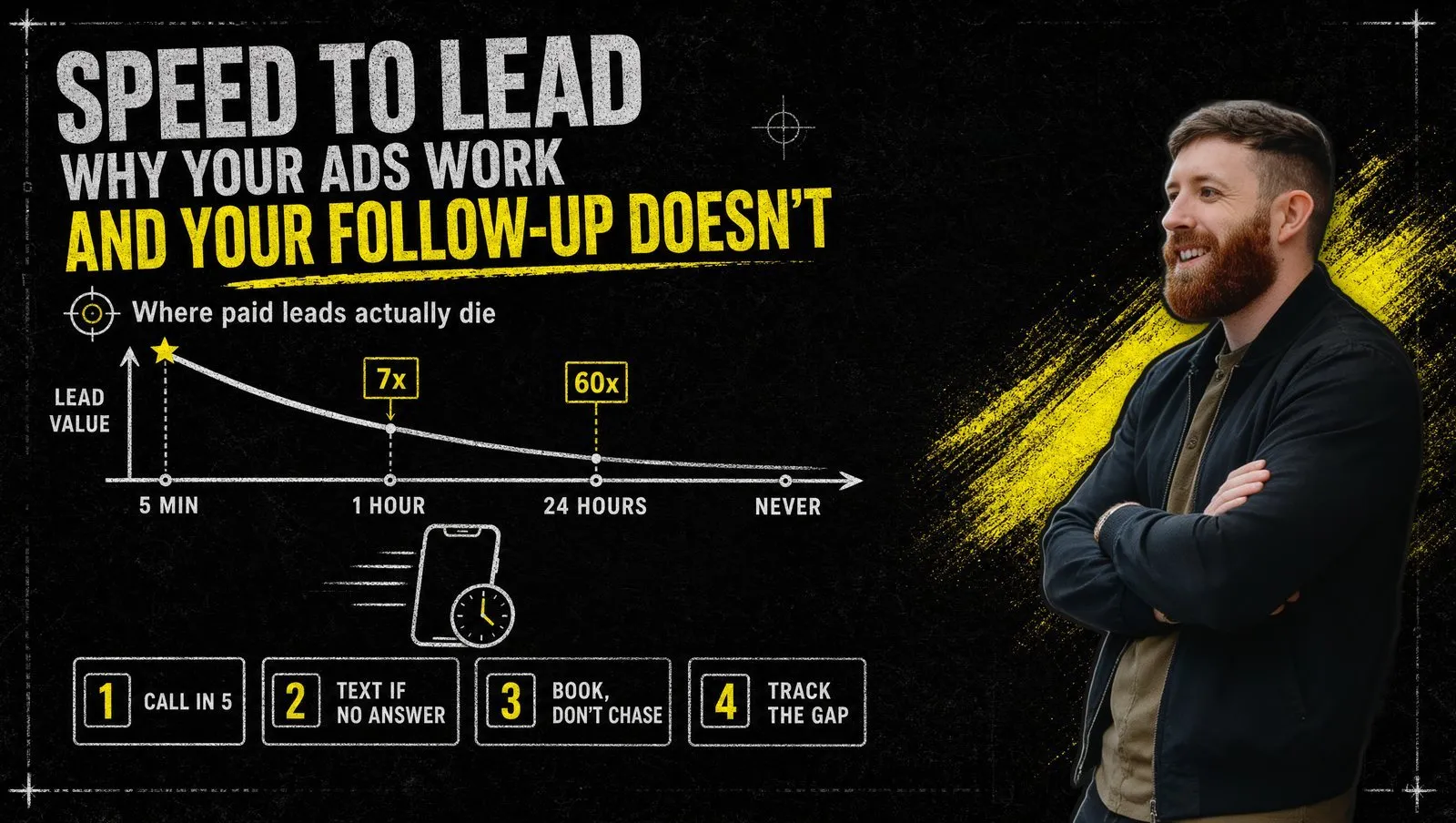
You've just paid £60 for a lead. Someone filled in your form at 10:14 on a Tuesday morning. It landed in an inbox. Somebody saw it at lunch, meant to call back, got pulled onto a job, and rang at 4:30. No answer. Left a voicemail. Never heard back.
That lead didn't go cold because the ad was wrong. It went cold because a competitor answered the phone at 10:19.
I've spent 13 years running paid campaigns for service businesses. The pattern I see most often isn't ads that don't work. It's ads that work perfectly well feeding a follow-up process that quietly throws half the money away. This article is about that gap, what the research says it costs, and how to close it without hiring a sales team.
What speed to lead actually means
Speed to lead is the time between a prospect raising their hand, by filling in a form, sending a WhatsApp, or requesting a callback, and your business making first contact with them. Lead response time is the same thing measured in minutes and hours. It is the most important number in your sales process that almost nobody tracks. Cut it from hours to minutes and the same leads, from the same ads, at the same cost, turn into more booked jobs.
What the research says about lead response time
The most-cited study on this is from Harvard Business Review. Researchers sent test enquiries to 2,241 companies and timed how long each took to respond. Only 37 percent replied within an hour. Nearly a quarter took more than 24 hours. Almost a quarter never replied at all. Among the companies that did respond within a month, the average wait was 42 hours.
The same research, drawing on 1.25 million leads, found that firms who tried to contact a prospect within an hour were roughly seven times more likely to have a meaningful conversation and qualify the lead than those who waited longer, and around sixty times more likely than firms who waited a full day. You can read the original at Harvard Business Review.
That study is from 2011. Two things have changed since. Buyers have got more impatient, and the phone in their pocket makes contacting three of your competitors in the same two minutes trivially easy. If anything the window is shorter now, not longer.
Here's the part that should bother you. In that study, the companies were mostly large firms with sales teams. You're a founder-led service business where the person answering enquiries is often also the person quoting, delivering and invoicing. Your response time is probably worse than theirs, and your leads cost you more per head.
The maths on a real service business
Take a fictional but typical example. Priya runs a £1.6m kitchen and bathroom fitting business in the West Midlands. She spends £4,000 a month on Google and Meta ads and gets around 65 leads from it. Cost per lead, roughly £62. She converts about one in eight into a surveyed, quoted job, and her average job is worth £9,500.
Her team responds to leads when they get a minute. In practice that means an average of five or six hours, and anything that arrives after 3pm waits until the next morning.
Now suppose she does nothing to the ads and simply gets first contact down to under ten minutes for every lead. Even a conservative lift, taking her from one in eight to one in six, means three extra jobs a month from the same 65 leads. That is roughly £28,000 a month in additional revenue from a change that costs her almost nothing in ad spend.
Flip it round. If she carries on at five hours, she is effectively paying full price for 65 leads and only competing properly for about half of them. Her real cost per contactable lead is closer to £120, and her real cost per job is double what her dashboard says.
This is why I get twitchy when a founder tells me their ads "aren't converting." Nine times out of ten, the ad platform is doing its job. The leak is downstream.
Why founder-led businesses are slow, and why it isn't laziness
Nobody sets out to ignore leads. The slowness is structural.
- Leads arrive in three places: a form notification email, a Meta lead-form inbox nobody checks, and a WhatsApp that pings the founder's personal phone.
- The person best placed to answer is on a job, in a meeting or driving.
- There is no rule for who owns a new enquiry, so everyone assumes someone else has it.
- Evenings and weekends are dead time, yet that's when a lot of homeowners and small business owners actually fill in forms.
- Nobody measures response time, so nobody knows it's a problem.
Fix the structure and the speed follows. You do not need more discipline. You need fewer decisions.
The follow-up system that closes the gap
This is the process we build into every Scale and Signature system at Codebreak. None of it needs a sales team. Most of it needs one afternoon of setup.
1. One inbox, one owner
Every lead source, forms, Meta lead ads, WhatsApp, phone, routes into a single CRM or pipeline. Not an email inbox. A pipeline with stages. One named person owns new enquiries during working hours, and there is a named backup. If you can't say who owns a lead that arrives at 2:15 on a Wednesday, that is your first fix.
2. Instant acknowledgement, then a real human inside five minutes
The moment a form is submitted, an automated text or WhatsApp goes out. Not "thanks for your enquiry." Something specific: "Hi Sam, it's Priya's team at Westbrook Kitchens. Got your enquiry about the en-suite. Calling you in the next few minutes, is now a bad time?" That message does two jobs. It stops them filling in your competitor's form, and it makes the call that follows expected rather than cold.
Then a person calls. Target: under five minutes. Realistic target for a small team: under fifteen. Anything over an hour and you are back in the pack.
3. If they don't answer, don't stop
Most first calls go to voicemail. That's normal. The mistake is treating one missed call as "tried." The sequence that works for our clients is call, text, call again the same day, then a short automated follow-up over the next five days that offers value rather than nagging. Something like a guide to what a kitchen project actually costs, or the three questions to ask any fitter before signing. Every touch has one link: book a call or a survey.
4. Book, don't chase
The goal of the first conversation is not to quote. It is to get the next step in the diary with a time and a date. A survey, a site visit, a fifteen-minute discovery call. Give them two options and let them pick. A lead with a booked appointment is worth several times a lead you are "following up with."
5. Cover the hours you're not working
A meaningful share of enquiries land in the evening and at weekends. You do not have to answer them at 9pm on a Saturday. You do have to acknowledge them instantly and be the first call they get on Monday morning. Automated acknowledgement plus a first-thing-Monday call list handles this. If your volume justifies it, an answering service that books appointments is cheaper than the leads you are currently losing.
6. Track the gap
Measure one number every week: median time from lead in to first human contact. Put it on the same dashboard as cost per lead. When we show a founder those two numbers side by side, the conversation about "the ads aren't working" usually stops. Over ten years and more than £45m of managed ad spend, the pattern has been consistent: the businesses that get response time under fifteen minutes see their cost per booked job fall without a penny more on ads.
What this looks like when it's running
A form comes in at 10:14. At 10:14 and 20 seconds, the prospect gets a text with a name on it. At 10:18, a person calls. If it goes to voicemail, they get a second text and a second call before lunch. If they still haven't answered, they're in a five-day sequence that quietly keeps your name in front of them and offers a booking link. Meanwhile the founder sees a weekly report: 65 leads, median response time 7 minutes, 11 surveys booked, cost per booked survey £364.
That's a business with a sales system, not a business with someone who's quite good at ringing people back when they remember.
Where Codebreak fits
We build and run marketing systems for owner-led UK service businesses doing £750k to £5m. The ads are the part everyone sees. The follow-up is the part that decides whether the ads pay. That's why our Scale and Signature systems include the multi-step nurture, the pipeline setup and the reporting that tracks a lead all the way to an enquiry, and in Signature, all the way to a sale. Over £400m of trackable client sales have come through that approach, and trackable is the word that matters. If we can't draw a line from the ad to the booked job, we don't count it.
If your ads are producing leads and your diary isn't filling up the way the numbers say it should, the problem is almost certainly in the first hour after the form lands. Book a free strategy call and we'll look at your lead flow, your response time and your cost per booked job, and tell you straight where the money's going.
Frequently asked questions
How quickly should you respond to a lead?
Aim for under five minutes for first human contact, and never more than an hour. Research from Harvard Business Review found firms that made contact within an hour were roughly seven times more likely to qualify the lead than those who waited longer. If a live call inside five minutes isn't realistic for your team, send an instant personalised text so the prospect knows a call is coming, then call within fifteen minutes.
What is a good lead response time for a UK service business?
Under fifteen minutes is good for a founder-led business without a dedicated sales team. Under five minutes is excellent and is where the biggest gains sit. Most businesses we audit are somewhere between two and six hours, with anything arriving after mid-afternoon waiting until the next day. Measure your median response time weekly and treat it as a KPI alongside cost per lead.
How do you convert leads into sales faster?
Route every lead source into one pipeline with a named owner, send an instant acknowledgement text, call within five to fifteen minutes, and if they don't answer follow up the same day by text and phone. The aim of the first conversation is to book a specific next step, a survey or call with a date and time, rather than to quote. Then track median response time and booked appointments per lead each week.
Why are my leads not converting even though my ads are working?
In most cases the ads are fine and the leak is in the follow-up. Leads that wait hours for a callback have usually already spoken to a competitor. Common causes are enquiries landing in several places nobody owns, the best person to call being on a job, no coverage for evenings and weekends, and nobody measuring response time. Fix the structure first, then judge the ads.
Do I need a sales team to improve speed to lead?
No. A single pipeline, an automated acknowledgement message, a clear rule for who owns new enquiries, and a short automated follow-up sequence will get most service businesses under fifteen minutes without hiring anyone. If your lead volume genuinely outgrows your team, an appointment-booking answering service is usually cheaper than the leads you are currently losing to slow response.