
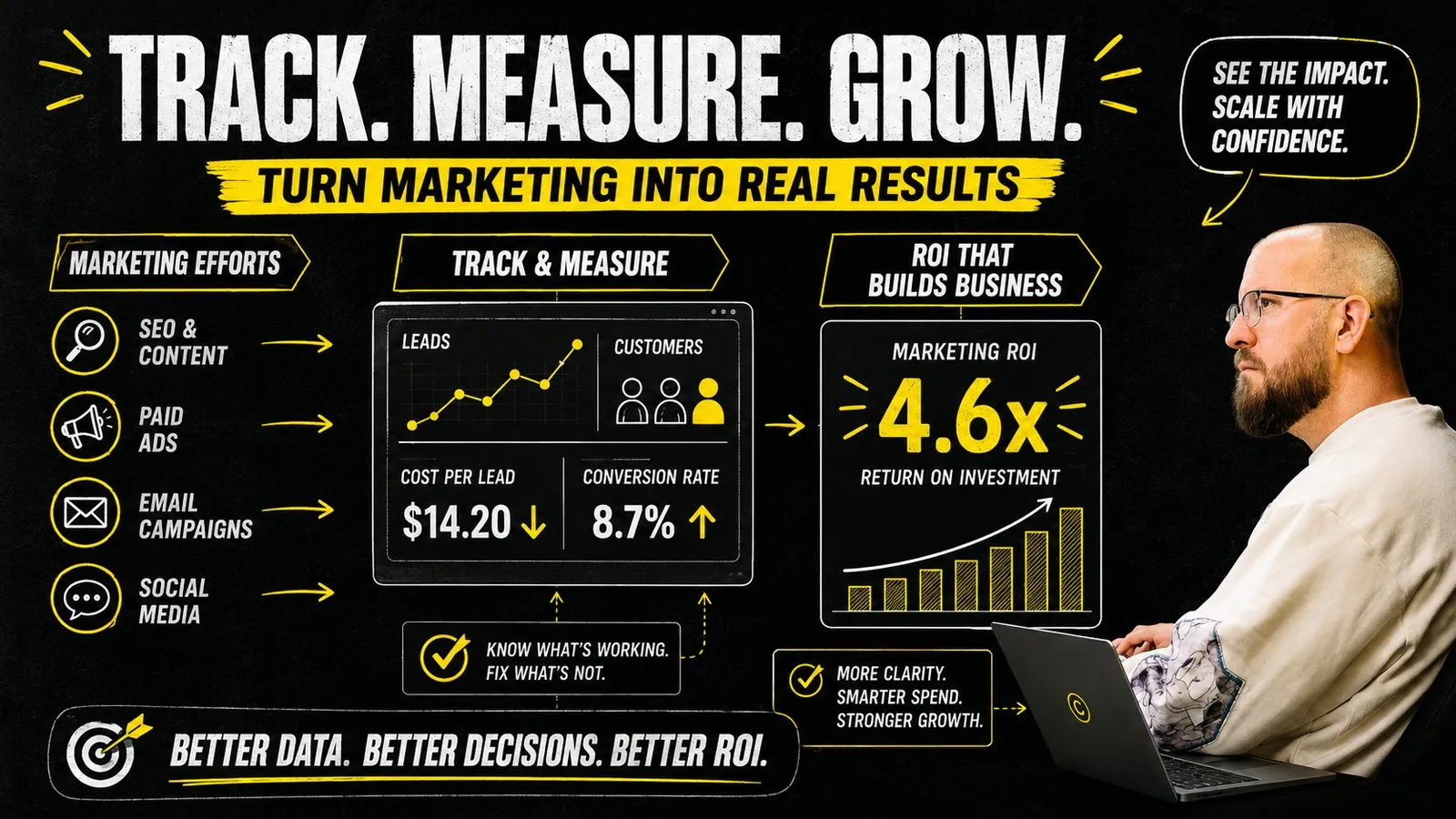
Marketing ROI tracking is the system that tells you which channels are generating revenue and which are quietly draining your budget. Yet many service business owners spending thousands on marketing each month still cannot tell you which channel made them money last quarter. They have dashboards full of clicks, impressions, and sessions, and no clear link to booked jobs, signed patients, or closed deals. This is not a data problem. It is a systems and integration problem.
Measuring your marketing return on investment is not about adding another tool to an already overcrowded stack. It is about building a connected system where most attributable spend can be traced to revenue, supplemented by modelling for indirect effects. At Codebreak, we wire this attribution infrastructure in before a single campaign goes live, treating it as a foundation rather than a finishing touch. This guide walks you through the metrics, models, tools, and common errors that determine whether your tracking actually reflects reality.
Why most service businesses can't see their true marketing returns
The root cause is a structural disconnect between how agencies report results and what business owners actually need to know. Agencies report clicks, reach, and cost-per-click. Owners need to know cost-per-acquisition, revenue generated, and leads closed. Most tracking is set up as a reporting layer over an existing campaign, not integrated into how leads are captured and closed. The result is partial data that can favour vanity metrics over revenue, reducing the actionable insight available to business owners.
The vanity metric trap
Impressions, click-through rates, and follower counts create the illusion of progress without confirming revenue impact. Consider a roofing company running Google Ads that generates 500 clicks in a month. Without call tracking, without CRM integration, and without a way to trace those clicks to booked jobs, the campaign looks productive on paper and may be haemorrhaging money in practice. A revenue-first reporting model starts with enquiries and closes the loop at invoice, not at click.
Tracking bolted on vs. built in from the start
Retrofitting tracking after campaigns are live produces unreliable, incomplete data. When UTM parameters are added inconsistently, call tracking is installed months after launch, or a CRM is used for invoicing but never connected to ad platforms, the data is permanently fragmented. You cannot go back and reconstruct accurate attribution from a broken foundation. The case for treating attribution architecture as the first step, not the last, is this: the earlier you build it correctly, the more of your spend history you can actually learn from.
The metrics that actually connect marketing spend to revenue
Not all metrics are created equal for service businesses. The ones worth tracking reveal the efficiency of your acquisition process at each stage, from first click to closed invoice. Framing these around a real scenario makes the relevance immediate rather than abstract.
Lead generation metrics: cost per lead, conversion rate, lead-to-customer rate
Cost per lead (CPL) tells you what you pay to generate a single enquiry. Conversion rate tells you what percentage of ad clicks or website visitors become leads. Lead-to-customer rate is the most revealing of the three: it shows how many of those leads actually become paying clients. A dental practice with a £45 CPL and a 5% lead-to-customer rate is in a very different position from one with a £90 CPL and a 25% close rate. You can have a low CPL and a poor close rate, which distorts any campaign ROI calculation and makes a failing campaign look efficient.
Revenue and acquisition metrics: CAC, CLV, and ROAS
Customer acquisition cost (CAC) is the total cost to acquire a single new customer: ad spend, agency fees, software, and internal time, divided by the number of new customers acquired. Customer lifetime value (CLV) is the multiplier that determines whether a given CAC is sustainable. A plumbing company that spends £3,000 on Google Ads in a month and acquires six jobs worth £800 each has a ROAS of 1.6 and a CAC of £500. Whether that is acceptable depends on how often those customers return and whether a £500 acquisition cost sits inside a profitable margin. ROAS measures campaign efficiency; CAC and CLV measure business sustainability. You need all three to form a complete picture of your marketing performance metrics.
Attribution models: choosing the right approach for your sales cycle
Attribution is the process of assigning credit for a conversion to one or more marketing touchpoints. The model you choose determines what your data tells you, and a poor choice leads to cutting channels that actually work whilst scaling ones that only appear to. The right model depends on sales cycle length and the number of touchpoints a prospect typically encounters before enquiring. For an overview of common approaches to assigning credit across touchpoints, see this piece on essential attribution models.
Single-touch attribution: when simpler is sufficient
First-touch attribution assigns all credit to the first interaction a prospect has with your brand, making it useful for understanding where awareness comes from. Last-touch assigns all credit to the final click before conversion, which helps identify which channel closes the deal. For service businesses with very short, direct sales cycles, such as an emergency plumber or a walk-in appointment booking, single-touch models can be a reasonable starting point. The limitation is clear: they ignore everything that happened between first awareness and final click, which means channels doing important warming work go unrewarded and get cut.
Multi-touch attribution: the more accurate approach for complex journeys
Service businesses with longer decision cycles need multi-touch models. Cosmetic dentistry, legal services, and high-ticket home improvements involve prospects who typically see multiple ads, visit the website several times, and read reviews before picking up the phone. Linear attribution distributes equal credit across all touchpoints. Position-based models, sometimes called U-shaped, give 40% credit to the first and last touch and distribute the remaining 20% across the middle interactions. Without credit for middle-funnel touchpoints, channels that warm prospects up appear to underperform and get cut prematurely. Multi-touch attribution is more complex to implement, but it reflects how service business customers actually make decisions.
How to set up marketing ROI tracking: tools and systems
A functional tracking stack for a service business has three core layers: call tracking, CRM integration, and a reporting layer for analytics and measurement. Each layer solves a distinct problem, and together they turn your campaign data from guesswork into an accurate revenue picture.
Call tracking and CRM attribution
Call tracking tools such as Ruler Analytics or CallRail assign unique phone numbers to different traffic sources, so you know whether an inbound call came from Google Ads, organic search, or a Meta campaign. Without this, phone-heavy service businesses are flying blind on a significant portion of their leads. CRM attribution closes the second gap: connecting your CRM to your ad platforms allows you to match a converted lead all the way back to the campaign that generated it. Without CRM integration, your ad platform reports conversions that never become paying customers, and your actual revenue attribution for each marketing channel stays invisible.
Analytics platforms for reporting and measurement
Google Analytics 4 is the free foundation: event-based tracking, cross-platform measurement, and direct integration with Google Ads. For businesses that need closed-loop CRM reporting and multi-touch attribution in a single system, HubSpot Marketing Hub is a leading option for B2B closed-loop attribution, with pricing starting around £630 per month at the time of writing, check the HubSpot pricing page for the current figure. Ruler Analytics is particularly well suited to UK service businesses that generate significant revenue through phone calls and offline conversions, offering keyword-level call attribution that feeds directly back into your ad platform reporting. The right choice depends on your monthly ad spend, sales cycle complexity, and how much of your lead volume comes through the phone rather than a form. For a primer on marketing attribution basics and how systems fit together, Adobe's overview is useful background reading.
When a fully managed tracking system removes the complexity
Building and maintaining a connected tracking stack, covering UTM governance, call tracking, CRM integration, and weekly revenue reporting, is rarely something an owner-led service business has the internal capacity to run consistently. Codebreak's approach is to wire the entire attribution infrastructure before the first campaign goes live. That means call tracking is active from day one, landing page conversion events are firing correctly, the CRM pipeline is connected to ad platforms, and weekly reporting is framed around revenue in versus cost to run, not clicks or impressions. Whether this infrastructure is built properly at the start is often the deciding factor between knowing what is working and simply guessing.
The tracking errors that silently distort your data
You do not need to be a data analyst to recognise when your reporting is structurally unreliable. These are the most common mistakes that produce misleading ROI tracking numbers, presented as practical warnings.
UTM errors and fragmented traffic sources
Inconsistent UTM parameters are among the most damaging sources of bad data in marketing ROI measurement. Mixed capitalisation creates duplicate traffic sources in GA4: "Google", "google", and "GOOGLE" are treated as three separate channels. Spaces in campaign names get URL-encoded and make reports unreadable. The fix is a single, enforced UTM naming convention applied across every campaign, every platform, and every link. Use lowercase throughout, hyphens rather than spaces or underscores, and automate UTM generation wherever possible to prevent human error. One important rule that is frequently broken: UTMs should only ever be added to external links, never to internal site navigation, or you inflate your own traffic figures.
Disconnected CRM and cross-device gaps
When your ad platform and your CRM operate independently, you cannot match a converted lead back to the campaign that generated it. Ad platforms report form fills and calls as conversions; your CRM holds the information about which of those actually became paying clients. Without the connection between the two, you are optimising towards enquiries rather than revenue, which are very different things.
Cross-device tracking compounds the problem: a prospect who sees an ad on mobile and books on desktop appears as two unconnected sessions without a unified tracking approach. A CRM with native ad integrations, or a Customer Data Platform that stitches the journey together, is one of the most reliable fixes available. It creates a single trackable profile from first click to closed deal, and alongside server-side conversion tracking and incrementality testing, it forms the foundation for accurate cost-per-acquisition data.
Building a marketing ROI tracking system that actually reflects reality
Marketing ROI tracking is not a single tool or a monthly report. It is a connected system of metrics, attribution, and data governance that needs to be designed before campaigns launch, not reconciled afterwards. The practical starting point for any service business is choosing three revenue metrics: CPL, CAC, and ROAS form a solid foundation. From there, connect call tracking and CRM to ad platforms, and enforce clean UTM conventions from day one.
If building and maintaining that infrastructure is not the best use of your time, the alternative is partnering with an agency that treats attribution as a core deliverable rather than an optional extra. Codebreak builds marketing ROI tracking into every client system from the outset, because the single measure of whether a campaign is working is whether it generates more revenue than it costs to run. If you want to know what that system would look like for your business, get in touch with the Codebreak team and we will show you exactly how we wire it up.
Frequently asked questions
What is marketing ROI tracking for service businesses?
Marketing ROI tracking is the system that links marketing spend to revenue so you can see which channels generate bookings, signed patients, or closed deals. It is less about adding tools and more about building a connected system where most attributable spend can be traced to revenue, supplemented by modelling for indirect effects.
Why can't many service businesses see their true marketing returns?
It is a systems and integration problem: agencies typically report clicks and impressions while owners need cost-per-acquisition, revenue generated, and closed leads. Tracking is often bolted on after campaigns start, producing partial, fragmented data that favours vanity metrics over revenue insights.
What are vanity metrics and why are they dangerous?
Vanity metrics are measures like impressions, click-through rates, and follower counts that look like progress but don't confirm revenue impact. A roofing company running 500 clicks a month looks productive on paper, but without call tracking or CRM integration you can't trace those clicks to booked jobs and may be wasting money.
Should tracking be installed before or after campaigns launch?
Tracking should be treated as the first step and built in before a campaign goes live. Retrofitting tracking later produces unreliable, incomplete data that you often cannot reconstruct, whereas early correct setup lets you learn from more of your spend history.
Which metrics actually connect marketing spend to revenue for service businesses?
The key ones are lead generation metrics — cost per lead (CPL), conversion rate, and lead-to-customer rate — and revenue and acquisition metrics like CAC, CLV, and ROAS. These reveal acquisition efficiency at each stage from first click through to closed invoice, rather than stopping at clicks or impressions.
How should businesses interpret CPL alongside close rates?
CPL alone can be misleading if you ignore how many leads convert to customers; a low CPL with a poor lead-to-customer rate can distort ROI. A dental practice with a £45 CPL and a 5% close rate is in a very different position from one with a £90 CPL and a 25% close rate, which shows how close rates change the economics dramatically.
How does Codebreak set up attribution for clients?
Codebreak wires attribution infrastructure before any campaign goes live, treating attribution as a foundational requirement rather than a finishing touch. Tracking is integrated into how leads are captured and closed, so reporting reflects revenue instead of just vanity metrics.