
Less than one-third of Google searches now result in a click. That figure has been climbing for a decade, but the arrival of AI-powered answer engines has accelerated it sharply: in early 2026, 68% of Google searches in the US ended without a click (SparkToro/SimilarWeb, 2026), and that number is rising fastest in exactly the informational and commercial categories that service businesses rely on for enquiries. At Codebreak, we have observed this effect directly across client campaigns. The businesses winning right now are not simply ranking higher; they are being cited inside the answer itself. That shift is what answer engine optimisation is designed to address, and this guide covers what it is, why it matters, and the practical steps to act on it.
This is not a theoretical concern for the future. ChatGPT Search, Google's AI Mode, Perplexity, and Microsoft Copilot are already intercepting the questions your prospective clients used to answer by clicking through to your website. If your content is not structured to be extracted and cited by those platforms, your brand risks being absent at the point of highest intent. There is no analytics trail to show for it, either.
What answer engine optimisation actually means
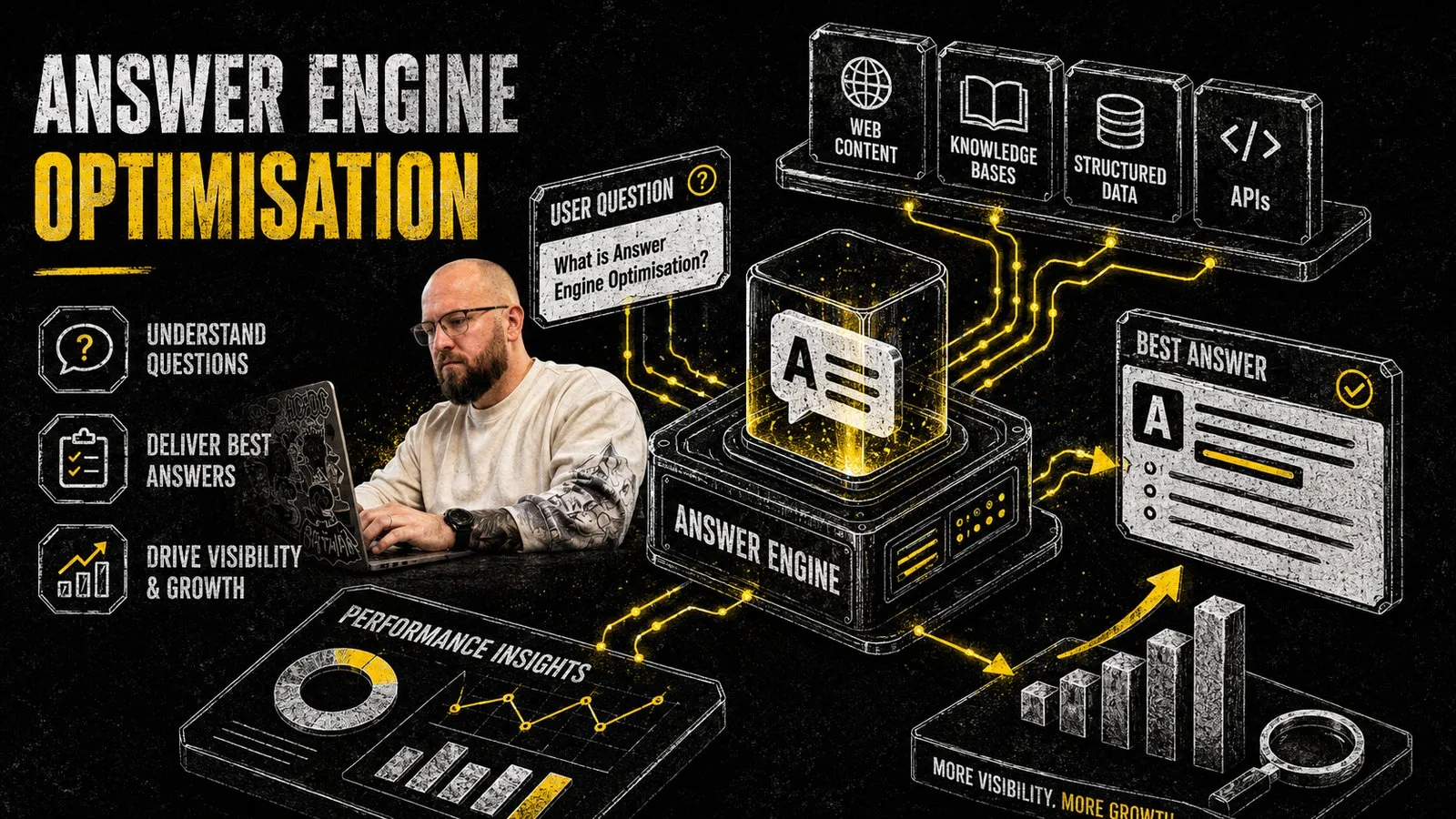
Answer engine optimisation (AEO) is the practice of structuring your content, authority signals, and technical markup so that AI-powered platforms extract, cite, and attribute your brand when generating responses to user queries. Traditional SEO earns a position on a results page. AEO earns a mention inside the answer itself. The distinction is similar to the difference between being listed in a directory and being the expert a journalist quotes directly: both provide visibility, but only one positions you as the authoritative source.
SEO focuses on crawlability, keyword signals, and backlink authority to influence ranking algorithms. AEO focuses on content structure, entity clarity, and schema markup to influence how AI models parse and attribute content during answer generation. The two disciplines share technical foundations but diverge sharply in execution. AEO rewards concise, structured, question-answering content over long-form prose written primarily to satisfy ranking signals. A piece of content that ranks well in traditional search can still be overlooked entirely by AI answer engines if it is not formatted for extraction.
It is also worth distinguishing AEO from GEO (Generative Engine Optimisation), a related but distinct discipline. AEO structures your content so it is quotable in response to a specific query. GEO builds brand-level authority so AI models trust your business as a source across many queries. They are complementary: AEO handles the content layer, GEO handles the authority layer. This guide focuses primarily on AEO execution.
Why AI-powered answers are reshaping organic visibility right now
The commercial case for taking answer engine optimisation seriously is straightforward. When AI Overviews appear in Google search results, the click-through rate for the top-ranked organic result falls from 7.6% to 1.6% (Semrush, 2026). Across all queries where an AI answer is generated, 80, 83% result in zero clicks to any website. For service businesses that have relied on informational blog content to drive enquiries into their pipeline, this is a structural problem, not a short-term fluctuation.
The impact is not uniform across all query types. Informational and educational content has been hit hardest, with CTR drops of 34, 61% documented in tracked studies. This matters because informational content is typically the top-of-funnel entry point for high-value service enquiries. When a prospective patient researches "how much does a dental implant cost in London" or a homeowner searches "what causes a boiler to lose pressure," they are at the beginning of a decision-making journey that ends in a purchase. If an AI engine answers that question and your brand is cited as the source, you gain exposure at the exact moment of highest intent, without the click ever happening.
For owner-led businesses, the practical implication is clear. Your prospective clients are already using ChatGPT Search, Perplexity, and Google AI Mode to research services like yours. The businesses being cited in those answers are gaining brand visibility that may not register in your analytics but often correlates with a measurable increase in enquiry volume. Answer engine optimisation is the discipline that captures that visibility surface systematically.
How AI answer engines select and attribute content
In 2026, there are six primary AI answer surfaces that matter for most service businesses: ChatGPT Search (pulling from Bing's index and direct crawls), Google AI Mode and AI Overviews (drawing from Google's index and Knowledge Graph), Perplexity (real-time web crawling with the most auditable citation model), Microsoft Copilot (Bing-integrated, with sentence-level citations), Brave Search, and Gemini. Claude is increasingly relevant as a research tool but currently operates with more limited web-sourcing capability than the six platforms above, making it a secondary priority for most service businesses at this stage. Each platform has different sourcing mechanisms and citation styles, and optimising for one does not automatically guarantee coverage across all.
Perplexity uses numbered inline footnotes linked to the specific sentence it extracted from your content, making it the most auditable platform in the category. ChatGPT cites approximately 15 sources per response and favours established, authoritative domains. Google AI Mode draws from its existing index but has a higher error rate than ChatGPT or Perplexity. Gemini cites roughly three sources per response. Understanding these differences matters because a citation strategy focused solely on Google will leave you invisible in the platforms where your prospective clients may be doing their most detailed research.
What gets cited across all platforms follows a consistent pattern. AI engines prioritise content that delivers a direct answer in the first one to two sentences after a heading, uses structured formatting such as short paragraphs, numbered lists, and HTML tables, and sits on a domain with clear entity signals. Content written as flowing narrative prose is significantly harder for AI engines to extract than content structured as question-answering blocks. Pages with FAQPage schema achieve citation rates roughly three times higher than unstructured content on equivalent topics, based on testing across client sites.
Answer engine optimisation: a 6-step implementation framework
Applying AEO systematically comes down to six areas of execution. These are not abstract principles; they are specific, implementable decisions that directly influence whether your content gets cited. Each step below reflects what AI-friendly content structure looks like in practice.
1. Question-based headings
Use H2 and H3 headings that mirror how users phrase queries. "What does a full roof replacement cost?" is extractable. "Our Roofing Services" is not. Each heading should function as a standalone prompt that the content beneath it answers directly. This is one of the most reliable signals in conversational search optimisation.
2. Lead with the answer
The first 40, 60 words beneath any heading should deliver the direct response. Context, caveats, and supporting detail come after. Perplexity's citation data indicates that 90% of top-cited sources answer the core question within the first 100 words of a section, structure your content accordingly.
3. Structured formatting
Use numbered lists for step-by-step processes, bullet points for discrete features or benefits, and HTML tables for comparisons. Place a new heading every 150, 300 words so each section functions as a self-contained, extractable chunk. This approach to AI-friendly content structure is one of the clearest differentiators between content that gets cited and content that does not.
4. Schema markup
Implement FAQPage schema for question-and-answer content, this achieves the highest citation rates of any schema type, with internal testing indicating an 89% citation lift in AI Overviews for optimised pages. Also deploy HowTo schema for procedural content, Organisation schema to anchor your brand as a recognised entity, and Article or BlogPosting schema to establish authorship and publication metadata. The single highest-leverage field is sameAs, which links your entity to trusted external profiles such as LinkedIn, Companies House, and industry directories that AI models already treat as reliable sources. Using structured data for AI attribution is no longer optional for competitive service businesses.
5. Topical authority
AI engines weight content from domains that demonstrate consistent publishing on a defined subject area. For service businesses, this means building a tightly scoped content library around your core service queries rather than publishing broadly across unrelated topics. Depth on a narrow subject outperforms breadth across many subjects, a key principle in any AI search optimisation strategy.
6. Measurement and brand signals
AEO requires different KPIs from traditional SEO. Track citation rate (the percentage of manually audited queries where your content is cited), citation share (your mentions versus total industry mentions), first-position rate (how often your brand is cited first), and platform coverage (how many distinct AI engines are attributing your content). Run a monthly manual audit of 50, 100 category-relevant queries across ChatGPT, Perplexity, Gemini, and Google AI Mode. In GA4, create a custom channel group filtering sessions from AI referral domains including chatgpt.com, perplexity.ai, and gemini.google.com.
Closing the attribution gap that AI answer engines create
Because most AI platforms do not pass standard referral data, a significant portion of AEO-driven enquiries will not appear in your analytics. A prospective client who discovers your business through a Perplexity citation, then visits your website directly, will show up as direct traffic. Without a deliberate attribution strategy, you will consistently underestimate the value of your answer engine optimisation investment.
There are three practical steps to address this. First, add an explicit "AI search" option to your contact form's "how did you find us?" field, so enquiries driven by AI discovery are captured at the point of conversion. Second, track branded search volume independently: an uplift in branded queries that does not correlate with paid spend or a new organic ranking is a reliable signal of AI-driven discovery. Third, monitor direct traffic patterns alongside your AEO activity; unexplained increases in direct sessions that coincide with citation growth are a consistent indicator of AI referral behaviour that your standard reports will not surface.
Healthy AEO performance benchmarks sit around 15, 25% citation share and a 30% or higher first-position rate across tracked queries. If you are running a monthly audit and neither metric is moving, the most common causes are a lack of structured formatting, missing or incomplete schema, or content that is not organised around the specific queries your prospective clients are actually typing into AI tools.
Where to go from here
Answer engine optimisation is not a replacement for SEO. It is the layer that sits on top of it, capturing the visibility that traditional rankings no longer guarantee as AI search continues to absorb the top of the funnel. For service businesses, the commercial logic is straightforward: if your prospective clients are using AI-powered tools to research which provider to use, and your competitors are being cited while you are not, you are losing high-intent enquiries without a single data point in your reporting to explain why.
The businesses that move on this earliest will build citation authority that compounds over time. Those that wait will find themselves in the same position as businesses that ignored local SEO five years ago: playing catch-up against competitors who got there first and built the domain authority to stay there.
Codebreak's AEO and GEO service is built specifically for owner-led service businesses who need optimisation for AI answers done properly, not pieced together from generic advice. Get in touch to find out what your current citation coverage looks like and where the gaps are costing you enquiries.
Frequently asked questions
What is answer engine optimisation (AEO)?
Answer engine optimisation is the practice of structuring your content, authority signals, and technical markup so that AI-powered platforms extract, cite, and attribute your brand when generating responses to user queries. Where traditional SEO earns a position on a results page, AEO earns a mention inside the answer itself.
How is AEO different from SEO?
SEO focuses on crawlability, keyword signals, and backlink authority to influence ranking algorithms. AEO focuses on content structure, entity clarity, and schema markup to influence how AI models parse and attribute content during answer generation. AEO rewards concise, structured, question-answering content, and a page that ranks well in traditional search can still be overlooked by AI engines if it is not formatted for extraction.
What is the difference between AEO and GEO?
AEO structures your content so it is quotable in response to a specific query. GEO (Generative Engine Optimisation) builds brand-level authority so AI models trust your business as a source across many queries. They are complementary: AEO handles the content layer, GEO handles the authority layer.
Why does AEO matter for service businesses now?
In early 2026, 68% of US Google searches ended without a click, and across queries where an AI answer is generated, 80 to 83% result in zero clicks to any website. When AI Overviews appear, the top organic result's click-through rate falls from 7.6% to 1.6%. If prospective clients research services through AI tools and your competitors are cited while you are not, you lose high-intent enquiries with no analytics trail to explain it.
Which AI answer engines should service businesses optimise for?
In 2026 the six primary surfaces are ChatGPT Search, Google AI Mode and AI Overviews, Perplexity, Microsoft Copilot, Brave Search, and Gemini. Each has different sourcing and citation mechanics, so optimising for one does not guarantee coverage across all. Claude is a secondary priority for now given more limited web-sourcing.
What kind of content do AI answer engines cite?
AI engines prioritise content that delivers a direct answer in the first one or two sentences after a heading, uses structured formatting such as short paragraphs, numbered lists, and HTML tables, and sits on a domain with clear entity signals. Flowing narrative prose is much harder to extract than question-answering blocks.
Does FAQPage schema improve AI citations?
Yes. Pages with FAQPage schema achieve citation rates roughly three times higher than unstructured content on equivalent topics, based on testing across client sites, and internal testing indicates an 89% citation lift in AI Overviews for optimised pages. It delivers the highest citation rates of any schema type.
How do I structure content so AI engines cite it?
Use question-based H2 and H3 headings that mirror how users phrase queries, lead with the direct answer in the first 40 to 60 words beneath each heading, and use numbered lists, bullets, and HTML tables. Add a new heading every 150 to 300 words so each section is a self-contained, extractable chunk.
What schema markup matters most for AEO?
FAQPage schema for question-and-answer content, HowTo schema for procedures, Organisation schema to anchor your brand as an entity, and Article or BlogPosting schema for authorship. The single highest-leverage field is sameAs, which links your entity to trusted external profiles such as LinkedIn, Companies House, and industry directories that AI models already treat as reliable.
How do I measure AEO performance?
Track citation rate (share of audited queries where you are cited), citation share (your mentions versus total industry mentions), first-position rate (how often you are cited first), and platform coverage (how many AI engines attribute you). Run a monthly manual audit of 50 to 100 category-relevant queries across ChatGPT, Perplexity, Gemini, and Google AI Mode, and build a GA4 channel group for AI referral domains.
Why don't AEO-driven enquiries show up in my analytics?
Most AI platforms do not pass standard referral data, so someone who discovers you via a Perplexity citation and then visits directly appears as direct traffic. To close the gap, add an 'AI search' option to your contact form, track branded search volume independently, and watch for unexplained direct-traffic increases that coincide with citation growth.
What are healthy AEO benchmarks?
Healthy performance sits around 15 to 25% citation share and a first-position rate of 30% or higher across tracked queries. If neither metric moves month to month, the usual causes are a lack of structured formatting, missing or incomplete schema, or content not organised around the queries prospective clients actually type into AI tools.