
The ads are working. Traffic is steady, maybe climbing. But the enquiries aren't coming, or there are far fewer than the numbers upstream suggest there should be. So you open Google Analytics for the third time this week and type the obvious question: why is my website not converting.
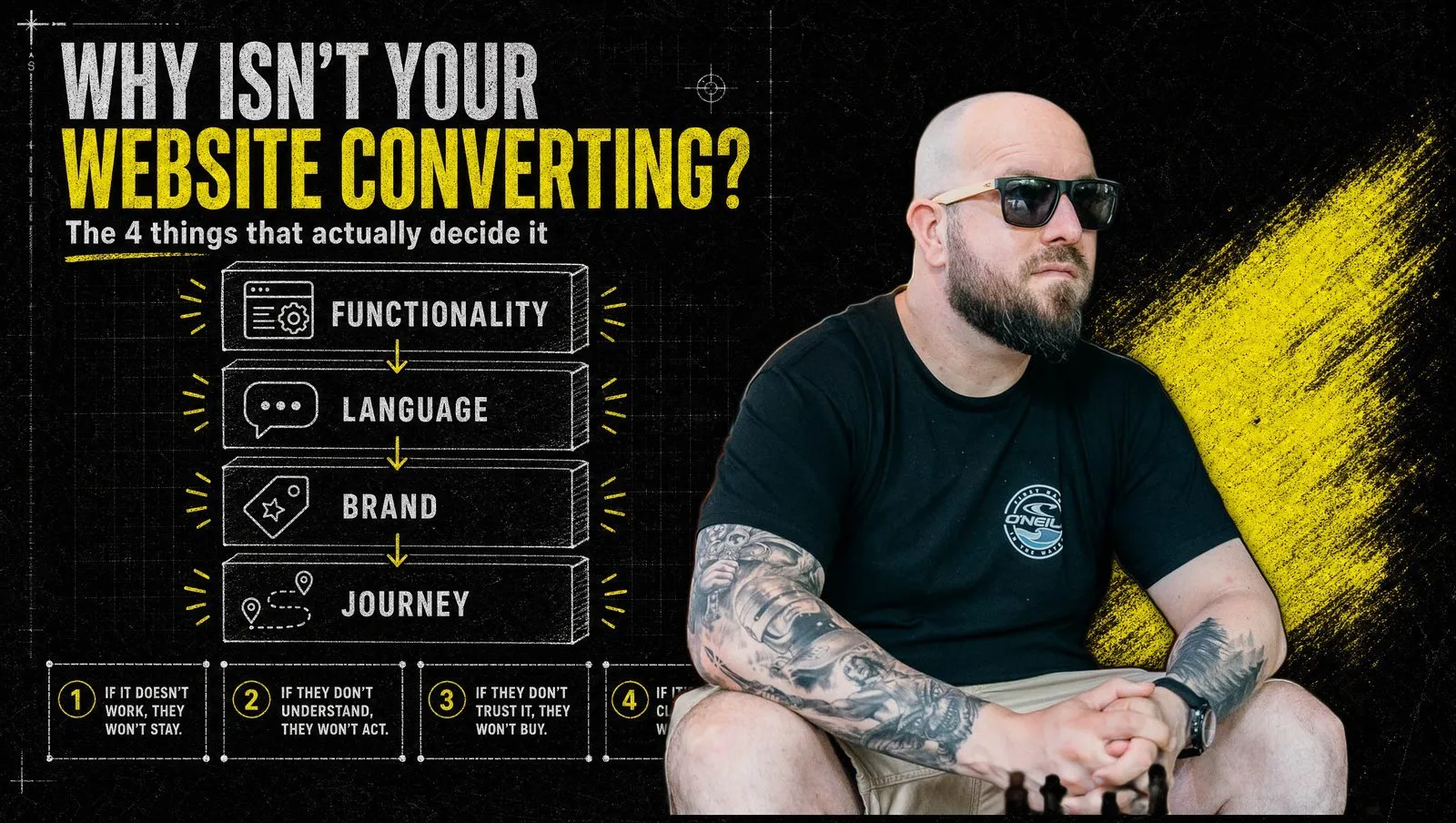
Most of the time the answer sits in one of four places. A website stops converting because it doesn't work properly on the device the visitor is using, because it talks about the business instead of the visitor's problem, because it doesn't match the brand that got them to click in the first place, or because it never makes the next step obvious. Diagnose which one you've actually got before you spend a penny on a redesign.
The four things that actually decide whether a website converts
Everything that goes wrong on a commercial website falls into one of these four buckets. Work through them in order, because the first one that fails is usually the only one worth fixing right now.
Functionality
Does the site actually work? Pages load fast on mobile, forms submit and land in an inbox someone checks, links go where they say they'll go, and the checkout or enquiry button does what it promises. This sounds obvious, which is exactly why it gets skipped. We still see contact forms that have been silently broken for months, with nobody any the wiser because nobody ever tried to use them.
Language
Does the copy speak the visitor's language, or the industry's? A page full of internal jargon, vague benefit statements, and no clear answer to "what's in it for me" will lose a visitor in seconds. The fix isn't more words. It's specific, plain language that names the problem the visitor actually has and says exactly how you solve it.
Brand
Does the site look and sound like the thing that made the visitor click? If your ad is sharp and confident but the landing page it leads to is generic and dated, you've planted a seed of doubt at the exact moment you needed trust. Consistency between what attracted someone and what they land on is doing more commercial work than most businesses realise.
Journey
Is the next step obvious? One clear action per page, with nothing competing for attention. A visitor who has to think about what to do next usually does nothing at all. If someone has to hunt for how to enquire, get a quote, or book a call, that's not a minor UX quirk, it's the whole page failing at its one job.
A case that still holds up
Joel wrote about a version of this in Stay Hungry: a luxury chocolate brand with genuinely impressive website traffic and sales that didn't come close to matching it. The site told the story of the brand and the artisan process in detail, but gave visitors no clear route from "interesting" to "buy". Reviews and testimonials that could have built trust were tucked away out of sight, and the path to actually purchasing was an afterthought.
The fix wasn't more traffic. It was restructuring the site around the product and the decision a buyer actually needed to make, with proof placed where it would do some good. Traffic that had been arriving for months with nothing to show for it finally started converting, because the page stopped talking about the brand and started selling the product.
That's usually the pattern. The traffic problem and the conversion problem are rarely the same problem, and throwing more of the first at a broken second one just burns budget faster.
How to work out which one you've actually got
- Open the site on your own phone, on mobile data, somewhere with average signal. If anything is slow, awkward, or broken, that's functionality, and it's the one to fix first regardless of anything else on this list.
- Read your homepage and your main service page out loud. If you hear your own industry's jargon more than your customer's actual problem, that's language.
- Pull up the ad or post that drove the click, then open the landing page straight after it. If the jump feels like landing on a different, less confident business, that's brand.
- Look at your highest-traffic page and find the one thing you want a visitor to do. If you can't find it in under five seconds, neither can they, and that's journey.
Whichever one fails first is the one worth fixing first. Fixing brand on a page that doesn't load properly on mobile achieves nothing.
Before you blame the website
Not every conversion problem is a website problem, and it's worth saying that plainly rather than using every traffic issue as an excuse to sell a rebuild. If the traffic itself is poorly targeted, no amount of landing page work will turn the wrong visitor into the right enquiry. Check who's actually arriving before you assume the page is at fault. Sometimes the honest diagnosis is that the ad targeting or search visibility needs attention before the website does.
Where Codebreak fits
We've managed over £45m in ad spend and tracked more than £400m in sales back to specific marketing activity across our clients, and the pattern repeats constantly: businesses pour money into getting more people to a page that was quietly losing most of them before the spend ever increased. A proper website built to convert fixes that at the source, with the functionality, language, brand and journey decisions made deliberately rather than inherited from whoever built the last one.
If you're not sure which of the four is actually broken on your own site, that's exactly the kind of thing worth a second pair of eyes before you commit to a rebuild. Book a free strategy call and we'll tell you straight which of the four needs fixing, and whether it's a redesign or something much smaller.
Frequently asked questions
Why is my website not converting even though traffic is good?
Good traffic with weak conversion almost always comes down to one of four things: the site doesn't work properly on the device people are using, it talks about the business rather than the visitor's problem, it doesn't match the brand that got them to click, or it never makes the next step obvious. Diagnose which one first, rather than assuming a full redesign is the answer.
What's a good website conversion rate for a UK service business?
It varies a lot by industry and traffic source, but a well-built lead generation page for a service business typically converts somewhere in the low single digits as a percentage of visitors into enquiries. Paid traffic to a dedicated landing page usually converts better than general organic traffic to a homepage, so compare like for like before judging your own number.
How do I know if my problem is traffic or conversion?
Check who's actually arriving on the site before assuming the page is at fault. If the traffic is reasonably well targeted and still isn't converting, the website is the more likely culprit. If the visitors arriving don't match your actual customer profile, no amount of landing page work will fix that, the targeting needs attention first.
Should I redesign my whole website or just fix specific pages?
Work out which of the four things, functionality, language, brand or journey, is actually failing before committing to anything. A full redesign only makes sense when the problem is structural. If the issue is weak copy or an unclear call to action on an otherwise sound site, that's a much smaller, cheaper fix than a rebuild.
What's the single biggest reason service business websites don't convert?
It genuinely varies by business, but journey problems are the easiest to miss because the page still looks fine. Visitors land, read something reasonable, and then have to work out for themselves how to enquire or get a quote. Most won't do that work. A single, unmissable call to action per page is one of the cheapest fixes on this list relative to the difference it makes.