
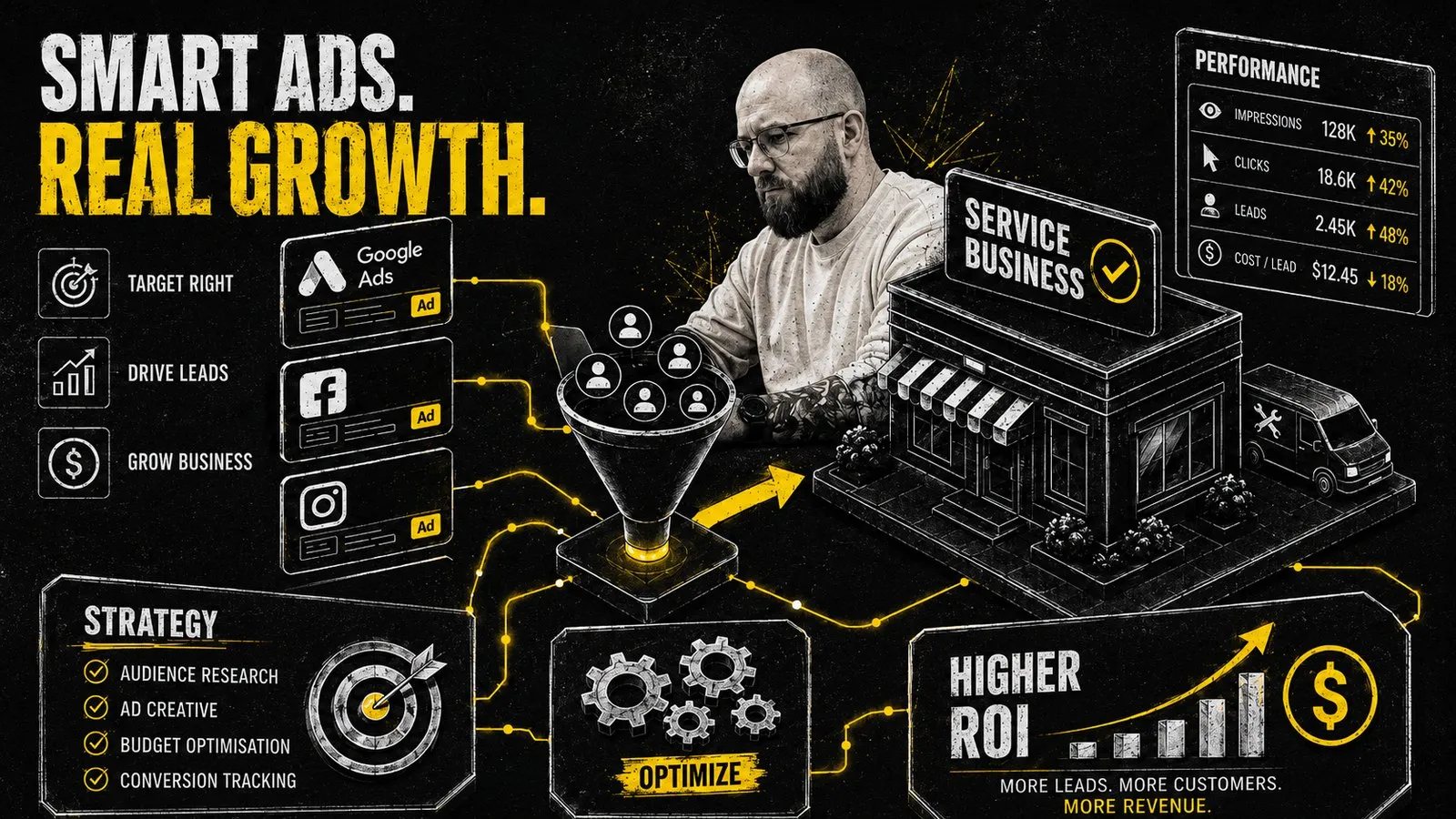
Service business owners in 2026 have more paid advertising options competing for their budget than ever before. The challenge isn't access to channels; it's knowing which ones generate revenue and which ones merely generate noise. Too many advertisers running paid campaigns measure impressions, clicks, and cost-per-click, platform metrics designed to keep you spending, not business metrics designed to help you grow.
The best paid advertising strategy for service-based businesses in 2026 looks fundamentally different from how most platforms teach you to think about media buying. Every channel decision, every budget allocation, and every campaign structure traces back to two questions: how much did each lead cost, and how many of those leads became paying clients? That frame changes everything, from which platforms you prioritise to how you structure your weekly reporting.
Why most paid ad spend fails to move the revenue needle
Google and Meta are both designed to optimise for the metrics they control: impressions, reach, clicks, and platform-reported conversions. For a service business, none of those are a business outcome. A roofing company generating 800 website visits a month from Google Ads isn't running a successful campaign if none of those visits request a quote. An aesthetics clinic running Meta ads with a low cost-per-click is wasting money if the leads are unqualified.
The disconnect happens at the reporting level. Many businesses, and many agencies, anchor their campaign reviews to click-through rate, quality score, and cost-per-click. These metrics matter operationally, but they shouldn't define whether a campaign is working. Benchmarks like these describe platform activity, not business performance.
When you restructure campaigns around cost-per-acquisition (CPA) and return on ad spend (ROAS), every downstream decision changes: which audiences to target, which landing pages to build, which channels to scale. Budget allocation becomes straightforward because every pound of ad spend has a clear test, does it return more in revenue than it costs to run? That single standard makes every other decision easier to defend.
Best paid advertising strategy for service businesses: Google Search and Local Service Ads
Google Search captures demand that already exists. When someone types "emergency plumber Birmingham" or "dental implant consultation London" into Google, they are ready to act. That intent quality is why Google Search consistently delivers higher close rates than social platforms across many service verticals, particularly local trades and immediate-need services, and why it should anchor your channel mix in most cases.
UK benchmarks for 2026 show professional services averaging £3.45, £8.00 CPC with CPAs ranging from £50 to £200 per enquiry. Home service trades sit lower, at £1.50, £3.80 CPC with CPAs between £25 and £80. Healthcare and dental typically land between £30 and £120 per acquisition. When average job values run into the hundreds or thousands of pounds, those acquisition costs are highly defensible.
Google Local Service Ads (LSAs) operate on a pay-per-lead model rather than pay-per-click, which changes the risk profile entirely. Eligibility and availability vary by region and vertical in the UK, so confirming your category qualifies before building LSAs into your strategy is worth doing early. For UK tradespeople and home service operators where LSAs are available, client-side data indicates they can deliver cost-per-booked-job significantly below what standard Search campaigns produce, with higher-intent leads supported by Google's verification badge. The right approach for most service businesses is to run both: LSAs for high-volume local intent, and standard Search campaigns for higher-value or more specific service terms where landing page control and keyword granularity matter.
Campaign structure matters as much as channel selection. Tightly themed ad groups, match types that filter unqualified traffic, and landing pages built around specific search intent rather than your homepage are non-negotiable. Conversion tracking must connect to actual enquiry submissions, not just page visits. Without that foundation, campaigns progressively optimise toward traffic that looks engaged but never converts.
Meta lead ads and retargeting: building pipeline volume
Meta doesn't capture existing intent; it creates it. Users on Facebook and Instagram aren't searching for your service, they're being introduced to it, which changes how you structure creative, audience targeting, and the conversion path. UK benchmarks show Meta CPCs around £1.40, £2.20, with CPAs achievable from as low as £17 for general service categories. The lower entry cost is attractive, but the challenge is lead quality: lower friction at the conversion point often means lower commitment from the lead.
Retargeting is where Meta generates its strongest return for service businesses. Users who have already visited your website, watched a video, or engaged with your content have demonstrated interest. Retargeting them with proof-based creative, case studies, testimonials, verified results, is significantly more efficient than running cold campaigns alone. A well-structured remarketing sequence moves through three phases: re-engagement with social proof, a direct conversion prompt such as a free consultation or quote request, and a scarcity or urgency layer for those who still haven't acted.
The temptation on Meta is to chase the lowest possible cost-per-lead. For service businesses with higher-value offerings, that's the wrong goal. A dental practice targeting implant consultations needs fewer, better-qualified leads, not hundreds of low-intent submissions. Using higher-intent form types, including qualifying questions in the lead form, and sending qualified lead signals back to Meta via the Conversion API all improve downstream conversion rates, even when they raise the cost-per-lead on paper. The metric that matters is cost-per-booked-client, not cost-per-form-submission.
Budgeting in the best paid advertising strategy for service-based businesses
The most reliable model for established UK service businesses is to allocate 8, 12% of revenue to marketing overall, with growth-focused operations sitting at the upper end. Within that total, paid media typically takes around 30% of the marketing budget. What matters more than the precise percentage is working backwards: define your revenue target, calculate the number of leads required based on your close rate, then multiply by your target cost-per-lead to arrive at a minimum viable ad budget. That approach makes the number defensible rather than arbitrary.
For businesses with longer sales cycles and higher-consideration purchases, a roughly 46:54 brand-to-activation split is well-supported by Binet and Field's IPA research. Brand activity, including video content, awareness campaigns, and thought leadership, makes direct response campaigns more efficient because it builds familiarity before the conversion moment. Newer businesses or those entering a new market should weight more heavily toward activation initially, then shift toward brand investment as audience size and retargeting pools develop.
The channel mix should follow your buyer's journey, not the platform's default recommendations. Home service trades with high search volume benefit most from Google Search and LSAs. Professional service firms with longer sales cycles often see stronger returns from Google Search for inbound intent combined with Meta retargeting for nurturing. High-ticket healthcare and aesthetics businesses typically need a heavier investment in trust-building creative before conversion campaigns can perform at scale.
Attribution and measuring real return without third-party cookies
Each platform reports conversions through its own lens, which leads to double-counting when you run campaigns across Google and Meta simultaneously. A lead who clicked a Google ad and later saw a Meta retargeting ad before booking will appear as a conversion in both platforms. For service businesses managing tight budgets, this distortion makes channel allocation decisions unreliable. Accurate CPA figures require looking at total spend against total tracked leads, not summing up what each platform claims to have generated independently.
With third-party cookies largely gone and UK GDPR enforcement ongoing, server-side tracking is now the baseline for reliable measurement. Implementing Meta's Conversion API (CAPI) and Google Enhanced Conversions passes conversion data directly from your server to the platforms, rather than depending on browser-based pixels that get blocked or consent-gated. Server-side setups consistently recover 15, 30% of conversions that browser tracking misses, which materially improves campaign optimisation signals and produces more accurate CPA figures to act on.
The reporting structure for a service business should centre on four metrics:
- Number of qualified enquiries
- Cost-per-enquiry
- Close rate
- Cost-per-acquired-client
Everything above that in the funnel is operational context, not performance measurement. Weekly reviews anchored to those four numbers make it possible to identify underperforming campaigns quickly, allocate budget toward what's working, and hold channels accountable for revenue rather than activity.
From individual campaigns to a connected paid media system
Many service businesses run Google and Meta as entirely separate activities, managed independently and evaluated on different KPIs. That fragmentation means retargeting pools are underutilised, channel synergies are missed, and there's no single view of what total ad spend is actually generating. A properly structured paid media system connects the channels: cold traffic from Google Search and Meta feeds into shared retargeting audiences, conversion data flows back to both platforms via server-side tracking, and all activity is evaluated against one benchmark.
A complete system includes the campaign architecture across platforms, the landing pages built for specific offers, the follow-up sequences that work the lead pipeline, and the reporting layer that surfaces revenue outcomes each week. The technical components, server-side tracking, Conversion API integrations, and audience structuring, are built once and maintained continuously. The strategic layer, where budget is allocated, offers are tested, and campaigns are scaled or paused, is reviewed on a weekly cycle against actual lead and revenue data.
This is how Codebreak structures paid media for owner-led service businesses. Rather than running campaigns and reporting on clicks, the model builds fully managed systems where Google Search, Meta, and retargeting work as connected channels, judged by a single question: does the revenue generated exceed the cost to run? If you want a framework built across substantial managed ad spend, with accountability to actual client revenue rather than platform dashboards, it's worth talking to a team that has built this across hundreds of owner-led service businesses.
The standard every paid campaign should be held to
Paid advertising in 2026 offers no shortage of options, but there is a shortage of service business owners measuring the right things. Google Search and Local Service Ads remain the highest-intent channels available. Meta lead ads and retargeting deliver pipeline volume when structured around lead quality rather than raw lead count. Budget that works backwards from revenue targets keeps spending disciplined. And attribution built on first-party data gives you the accurate CPA figures that make channel decisions defensible.
The best paid advertising strategy for service-based businesses isn't about picking the right platform. It's about building a system where every channel, every campaign, and every pound spent is evaluated on the same measure: revenue in versus cost to run. If that's the standard you want to hold your paid media to, contact Codebreak for a free audit of your paid strategy and find out where your current spend is falling short.