
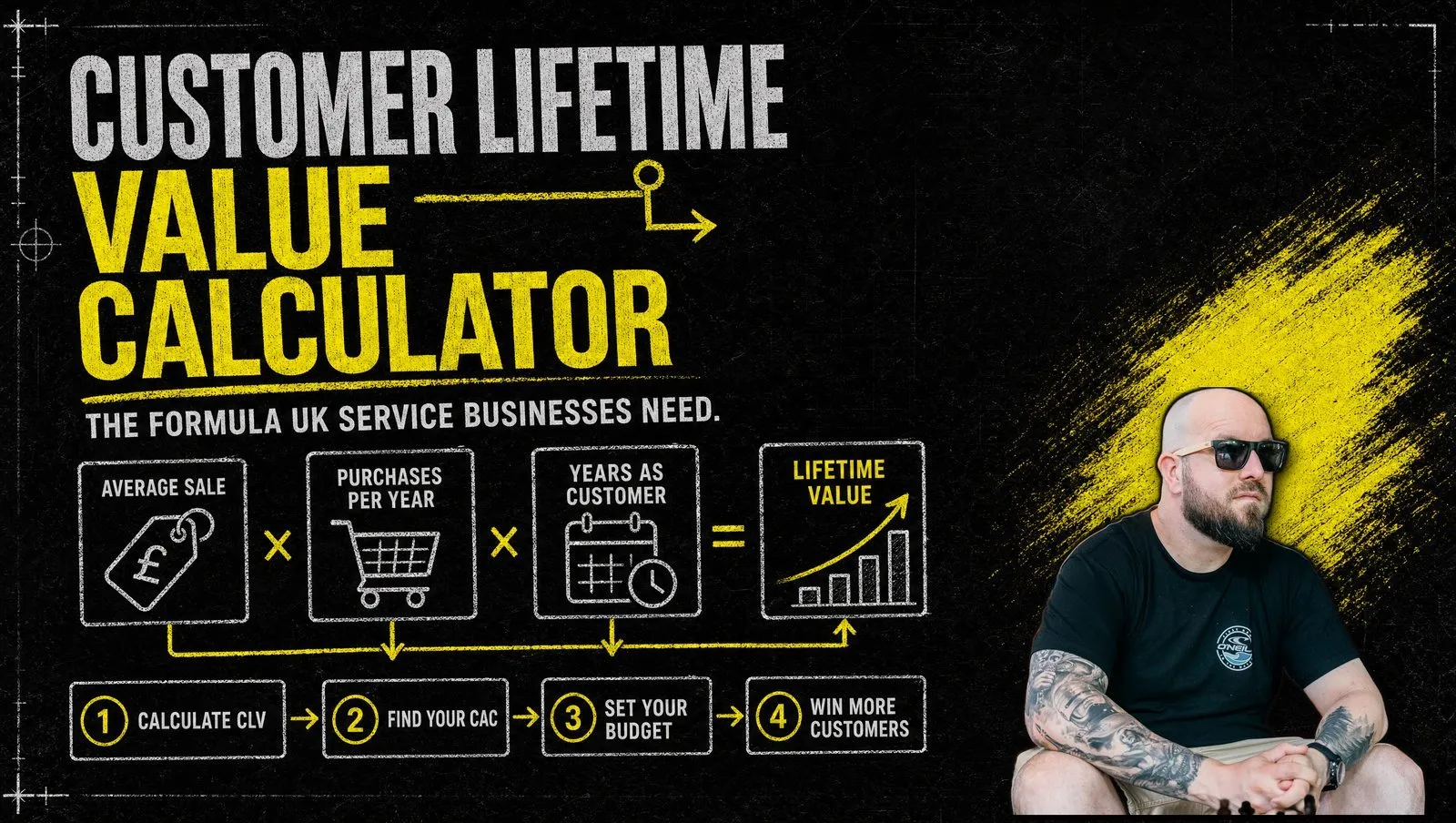
Ask most founders what a customer is actually worth and you'll get a shrug, or a number that's really just the average invoice. That gap matters more than it looks. If you don't know what a customer is worth over the whole time they stay with you, you can't know what you can actually afford to spend to win one, and every decision about ad spend becomes a guess dressed up as a strategy.
Customer lifetime value is worked out with one simple formula: average sale value, multiplied by how many times a customer buys from you in a year, multiplied by how many years they typically stay. Run that once for your business and you've got a real number to measure every pound of marketing spend against, instead of a feeling.
Here's how to run a customer lifetime value calculator properly for a UK service business, and what to do with the number once you've got it.
Why most founders have never worked this out
It's not that the maths is hard. It's that nobody's ever sat down and asked the question properly. Most founders know their average job value. Few know how often a customer comes back, and almost none have multiplied the two by how long a relationship with a customer typically lasts.
That's the gap that keeps marketing spend feeling like a leap of faith. Without a lifetime value number, £150 to win a customer looks expensive. With it, the same £150 can look like the best trade you'll make all week.
The customer lifetime value calculator
The formula is this:
Average sale value × purchases per year × years as a customer = customer lifetime value
Take Pete, who runs an HR software business. His customers pay £500 a month, so £6,000 a year, and the average customer stays just over four years before moving to a bespoke system.
£6,000 × 4 = £24,000 lifetime value
Pete wanted 15 new customers a month and was spending £10,000 on marketing to get them. On paper, bringing in £7,500 a month of new transactional value against a £10,000 spend looked like a loss. But multiply those 15 customers by a £24,000 lifetime value and that same £10,000 is chasing £360,000 worth of business. That's the number that actually matters, and it's the one most businesses never calculate.
For a business with a lower-value, higher-frequency model
The formula works just as well for a hair salon, a gym or a clinic. Rachel runs a salon where the average visit is £80, a regular customer comes in six times a year, and most stay for around a decade.
£80 × 6 × 10 = £4,800 lifetime value
That number is what let Rachel decide, with confidence rather than a guess, what she was willing to spend to win a new regular.
Customer acquisition cost: the number this changes
Lifetime value only becomes useful once you compare it to what it actually costs you to win a customer. That's your customer acquisition cost, worked out as:
Sales and marketing spend ÷ customers acquired = customer acquisition cost
Rachel spent £1,500 on a campaign and brought in six new regulars that month.
£1,500 ÷ 6 = £250 cost per customer
Against a £4,800 lifetime value, that's not a cost. It's a return of nearly 20:1 over the life of the relationship, and it's the kind of number that turns "can I afford to advertise" into "how quickly can I spend more".
What to do once you know both numbers
Knowing your lifetime value and your acquisition cost means you can finally choose how many customers you want, rather than taking whatever referrals happen to bring in that month. A few things follow directly from the maths:
- Set a real ceiling on what you'll pay for a lead. If a customer is worth £4,800 and you're happy with a 10:1 return, you know you can spend up to £480 to acquire one and still be comfortable.
- Stop judging a campaign by its first month. A customer who costs more to acquire than they spend in month one can still be hugely profitable once you account for the full relationship.
- Factor in referrals. If one in three customers refers another, your real acquisition cost per customer is lower than the raw spend-per-customer figure suggests. Build that into your sums rather than treating referrals as a bonus you can't plan around.
Where this breaks down
A customer lifetime value calculator gives you an average, and averages hide detail. A customer who signs up through a discount code rarely behaves the same as one who found you through a recommendation, so it's worth recalculating lifetime value separately for your main service lines rather than relying on one blended figure for the whole business. It's also worth revisiting the number every few months rather than once and forgetting it. Pricing changes, retention changes, and a lifetime value worked out two years ago can quietly stop reflecting what's actually happening in the business.
Where Codebreak fits
We build done-for-you marketing for UK service businesses that have outgrown referrals but want every pound of spend tied back to a real number, not a vanity metric. Knowing your lifetime value and acquisition cost is step one. Turning that into a repeatable system of enquiries is the part we handle.
If you want help working out your own numbers, or turning them into a marketing budget that actually makes sense, book a free strategy call and we'll run through it with you.
Frequently asked questions
What's the easiest way to calculate customer lifetime value for a small UK business?
Multiply your average sale value by how many times a customer buys from you in a year, then multiply the result by how many years they typically stay. For most small service businesses that's three numbers you can pull straight from your own accounts in a few minutes, no spreadsheet modelling required.
What's a good customer lifetime value calculator formula for a service business?
The formula that works best for service businesses is simpler than the churn-based models built for SaaS or ecommerce: average sale value x purchases per year x years as a customer. It skips retention curves and discount rates, which matter less when most service businesses keep a customer for a known number of years rather than an open-ended subscription.
What's a good customer lifetime value to customer acquisition cost ratio?
A ratio of 3:1 is often cited as a healthy minimum, meaning a customer is worth at least three times what it costs to acquire them. Anything close to 1:1 means you're barely covering your costs, while a much higher ratio, like the examples in this guide, usually means there's room to spend more and grow faster.
How often should I recalculate customer lifetime value?
Every few months, or whenever your pricing, retention or service mix changes meaningfully. A lifetime value worked out two years ago on old prices and an old average customer lifespan will quietly mislead every decision you make with it.
Does customer lifetime value work for businesses with one-off customers, not repeat ones?
It still works, but the number will be lower and closer to your average transaction value, since the "purchases per year" and "years as a customer" parts of the formula shrink towards one. In that case, referrals and reviews matter even more, since a happy one-off customer sending you new ones effectively adds value the formula alone won't capture.