
You know how many leads came in last month. You probably don't know what percentage of them actually became paying customers, and whether that number is good, average, or a sign something in your process is broken.
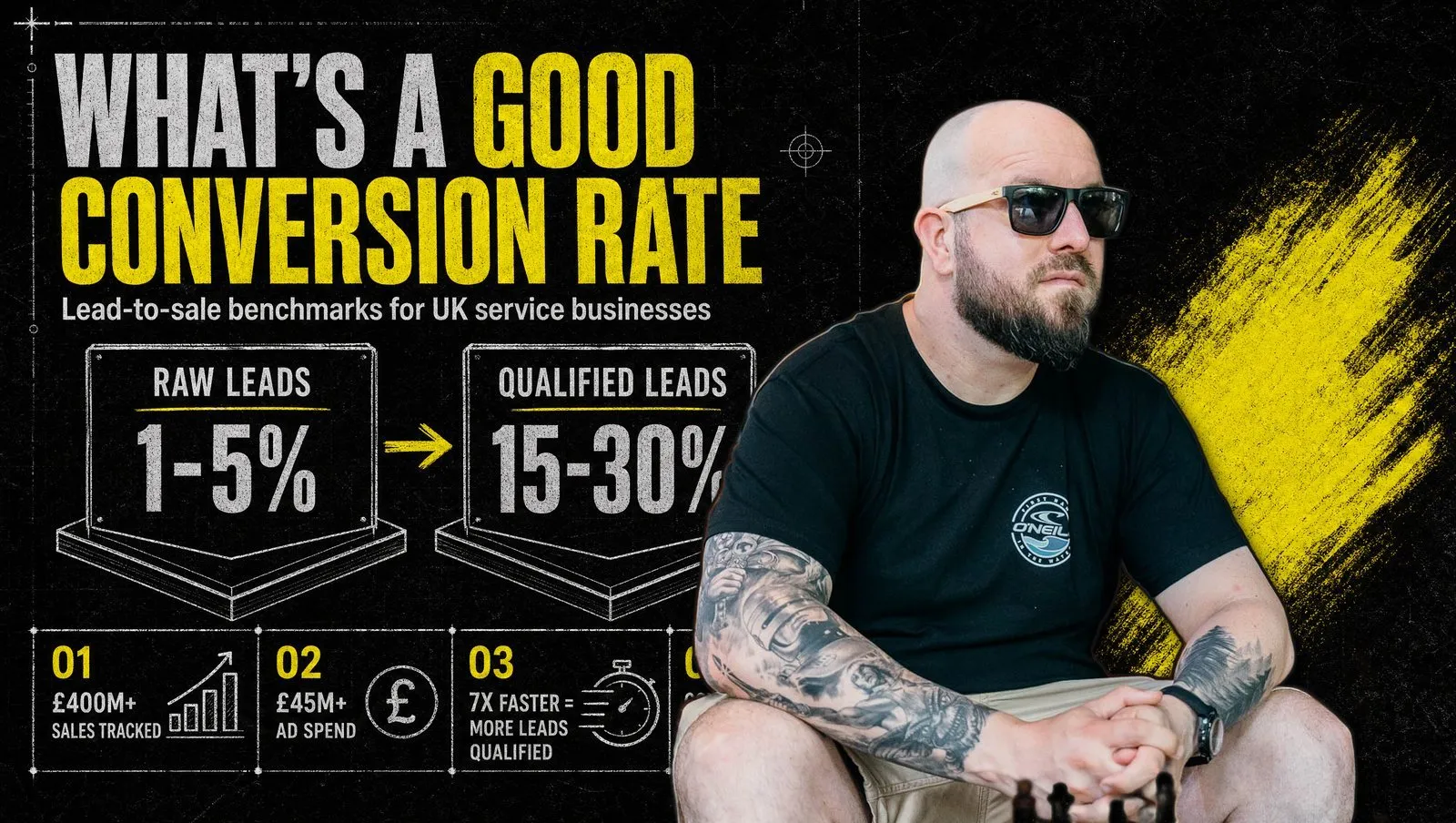
A good lead-to-sale conversion rate depends entirely on what you're counting as a "lead". For raw, unqualified enquiries, forms, calls, cold traffic, 1% to 3% converting into paying customers is healthy. Once a lead has actually been qualified as sales-ready, that number should climb to 15% to 30%. Most founders compare the wrong two figures and worry for nothing, or celebrate a number that's hiding a real problem.
What counts as a "lead" and what counts as a "sale"
Before you can benchmark anything, you need to agree what you're actually measuring. Most founders get this wrong, and it's the reason two businesses can both claim a "10% conversion rate" and mean completely different things.
- A lead should mean a genuine enquiry: a form fill, a call, a booked consultation. Not a click, not a page view, not someone who liked your ad.
- A sale should mean money in the bank, or a signed contract. Not a "qualified opportunity". Not a quote sent.
Your lead-to-sale conversion rate is sales divided by leads, over the same period, multiplied by 100. That's it. If you're tracking anything softer than that, you're not measuring conversion, you're measuring hope.
What's a good lead-to-sale conversion rate in 2026
This is where most benchmark articles mislead you, by quoting a single number for a metric that's actually two different things.
- Raw lead to paying customer, every enquiry you get, qualified or not, converts at 1% to 3% on average, according to benchmark research citing HubSpot's sales data.
- Sales-qualified lead to paying customer, once someone's actually been through discovery and fits, sits at 15% to 30%. Average performers close around 20%, the best close closer to 30%.
- Paid search leads specifically tend to close at 8% to 20% once they reach a first sales conversation, according to Upcision's 2026 close rate data.
- Referrals close highest of all, typically 30% to 50%, which is exactly why they feel so much easier to sell than cold leads.
If you run a £1m to £5m service business, professional or trade, the number to actually watch is raw lead to paying customer. It's the one that tells you whether the whole system, marketing and sales together, is working. A healthy qualified-lead close rate can sit right next to a broken raw-lead conversion rate if leads are getting lost or ignored before anyone qualifies them.
Why your number is probably lower than it should be
Take a business like Dave's. Roofing and building firm, £1.8m turnover, decent ad spend, plenty of leads landing in the inbox. His raw lead-to-sale rate was sitting under 1%, well below the 1% to 3% you'd expect even from an average process. Not because his pricing was wrong or his service was weak. Because of what happened between the enquiry and the phone ringing.
The two most common reasons a lead-to-sale rate underperforms the benchmark:
The follow-up is too slow
Firms that make contact within an hour are roughly seven times more likely to qualify a lead than firms that wait longer, and around sixty times more likely than firms that wait a full day, according to Harvard Business Review research we've covered in detail in Speed to Lead. Only 37% of companies respond within that first hour. If your ads are working but your conversion rate isn't moving, this is the first place to look, not your targeting.
Nobody owns the number
Lead-to-sale conversion rate falls through the cracks when marketing owns lead volume and sales owns closing, and nobody's job is the bit in between. If you can't say, right now, what your conversion rate was last month, that's the real problem. Not the number itself, the fact that nobody's watching it.
How to actually improve it
- Track it monthly, by source. A lead from a referral converts differently to a lead from a cold Facebook ad. Blend them together and you can't tell what's working.
- Get to five minutes, not five hours. Every hour of delay costs you measurable conversion. This is the cheapest fix on this list and the one most businesses ignore.
- Qualify before you pitch. A rushed sales call that skips discovery closes fewer deals than a slower one that actually establishes fit first.
- Separate cost per lead from cost per sale. A cheap lead that never converts is more expensive than an expensive one that does. Most founders only ever look at the first number.
None of this requires new ad spend. It requires knowing the number, then fixing whichever half of the funnel is actually leaking.
The number that actually matters
We've tracked over £400m in sales back to specific campaigns across the businesses we manage, and £45m in ad spend besides. Not impressions. Not clicks. Sales. We see this exact pattern often, a business with a perfectly respectable qualified-lead close rate and a raw lead-to-sale rate nowhere near where it should be, because nobody separated the two numbers in the first place.
If you've built something people want, referrals prove that, your raw lead-to-sale conversion rate should be closer to 3% than 1%. If you don't know your number, or you don't know which of the two you're even measuring, that's the first thing to find out. If you do know it and it's low, we'd rather show you exactly where it's leaking than sell you more leads to leak.
Book a free strategy call and we'll walk through your numbers with you, no pitch deck required.
Frequently asked questions
What is a good lead-to-sale conversion rate?
For raw, unqualified leads, 1% to 3% converting into paying customers is healthy, according to benchmark research citing HubSpot's sales data. Once a lead has been qualified as sales-ready, that number should climb to between 15% and 30%. The two numbers measure different things, so compare like with like, or you'll either worry for nothing or miss a real problem.
What's the difference between a raw lead-to-sale rate and a qualified lead-to-sale rate?
A raw lead-to-sale rate counts every enquiry you get, qualified or not, against how many became paying customers. A qualified, or sales-qualified, lead-to-sale rate only counts enquiries that have already been through discovery and fit your ideal customer. The second number will always look better, which is why quoting it alone is misleading.
Why is my lead-to-sale conversion rate dropping even though lead volume is up?
This usually means the extra volume is lower quality, the follow-up process hasn't scaled with it, or both. More leads without more capacity to respond quickly just dilutes your conversion rate, it doesn't grow your revenue.
How do I calculate my lead-to-sale conversion rate properly?
Divide the number of sales by the number of leads for the same period, then multiply by 100. Track it monthly and by lead source, because blending referrals with cold ad traffic hides which channel is actually converting.
What's a good lead-to-sale conversion rate for a small UK service business?
For a £1m to £5m UK service business, the number to watch is raw lead-to-sale conversion, since it captures the whole system, marketing and sales together. Expect 1% to 3%. Once you're also tracking qualified-lead conversion separately, 15% to 30% is the healthy range there, with referral-sourced leads closing at the very top of that band.