
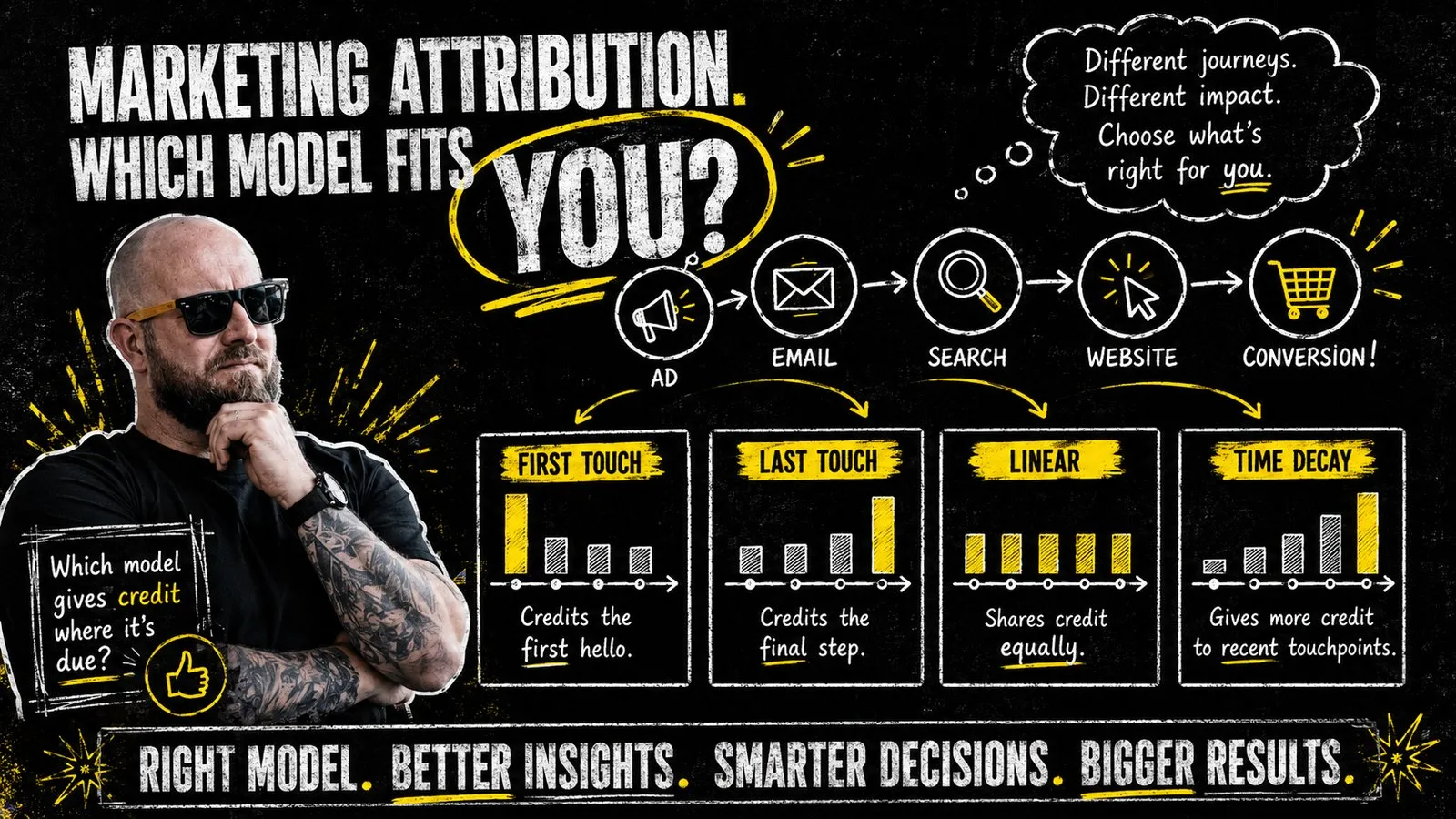
Most service business owners are handed a spreadsheet of clicks, impressions, and cost-per-click figures and expected to feel confident about where their next client is coming from. They're not, and they shouldn't be. Those numbers tell you how busy your marketing is, not whether it's working. Marketing attribution is the system that answers the question every owner actually cares about: which specific activity is generating revenue?
Attribution modelling isn't just an analytics topic. It's a commercial decision that directly shapes where your budget goes, which channels you scale, and which ones you quietly defund. Service businesses face a specific challenge here that most attribution guides skip entirely: your prospects don't enquire immediately. They research, compare, forget about you, come back, and eventually make contact weeks or months after their first interaction. Standard attribution setups aren't built for that. Budget wasted on the wrong channel, or cut from the right one, is the direct consequence of that blind spot, and the gap between what most setups report and what's actually driving revenue can be substantial.
At Codebreak, this is precisely why every client is measured against a single benchmark: revenue in versus cost to run. Everything else is context. By the end of this article, you'll know which attribution model fits your business, where the common pitfalls are, and what a reliable reporting setup actually looks like in practice.
What marketing attribution actually is
A prospective client rarely finds a service business and books in one step. They might see a Google ad, read a blog post, find you on Google Maps, and then search your business name directly before making an enquiry. Without proper marketing measurement, the owner typically credits that final branded search and, as a result, underfunds everything that built the case beforehand. Awareness channels get cut; the branded search budget grows. Enquiry volume eventually declines, and nobody's quite sure why.
Attribution modelling is the set of rules that decides which touchpoints in the customer journey receive credit for a conversion. There are two broad categories: single-touch models, which assign all the credit to one interaction, and multi-touch attribution, which distributes credit across several interactions throughout the journey. The model your business uses directly shapes how budgets get allocated and how channels get evaluated, which makes the choice commercially significant rather than a technical preference. For a solid introductory overview of the basic concepts, see marketing attribution basics.
Marketing attribution models compared
First-touch and last-click attribution
First-touch attribution assigns 100% of the credit to the first interaction a prospect had with your business. Last-click attribution assigns 100% to the final touchpoint before an enquiry or purchase. Both have legitimate uses: first-touch helps you understand what generates awareness; last-click helps you identify what closes. The shared flaw is that both ignore everything in between, which for a service business with a 60- to 90-day decision window is a substantial blind spot.
Linear, time-decay, and position-based attribution
Linear attribution distributes equal credit across every touchpoint in the journey. Time-decay attribution gives progressively more credit to touchpoints that occur closer to conversion. Position-based, or U-shaped, attribution splits the credit with 40% going to the first touch, 40% to the last touch, and the remaining 20% distributed across the middle interactions. Linear suits businesses that want to value every channel equally; time-decay works better for shorter consideration cycles; position-based suits businesses that want to give weight to both the moment of discovery and the final conversion trigger.
Data-driven attribution
Data-driven attribution, now the default model in Google Ads and Google Analytics 4, uses machine learning to analyse both converting and non-converting paths and assigns credit based on the probability that each touchpoint actually contributed to the outcome. It's the most accurate option available, but it requires sufficient data volume to produce reliable results. For service businesses with consistent lead flow and enough conversion data, this is the model that many performance-focused agencies use as the foundation of their reporting, provided data volumes are sufficient to make the machine learning reliable. Google's move away from strict last-click defaults and the industry conversation around modelling are covered in more detail in industry reporting on Google Ads changing its default to data modelling. If you want context on how recent AI and ML developments affect marketing workflows, see how generative AI is revolutionising marketing.
Why service businesses need a different approach to attribution
Consider a roofing company with a six-week average decision window. Standard last-click attribution with a 30-day lookback will systematically miss the early touchpoints that started the conversation. A prospective customer sees a Meta ad in week one, reads two blog posts in week three, then searches the company name directly and requests a quote six weeks later. Last-click credits the branded search and ignores everything else. The conclusion the business draws is that organic brand search is the primary driver of new leads, which results in cutting the Meta budget that generated the awareness in the first place.
The guidance here is straightforward. For sales cycles under 30 days, time-decay or data-driven attribution works well within standard settings. For cycles of 30 to 90 days, position-based or data-driven with an extended lookback window is more reliable. For complex service businesses with cycles beyond 90 days, multi-touch attribution combined with CRM data tracking is the minimum requirement. For a detailed discussion of the benefits and shortcomings of multi-touch approaches, see Matomo's analysis of the benefits and shortcomings of multi-touch attribution.
One configuration change has an outsized impact for service businesses: the GA4 lookback window. For non-acquisition conversion events, the default lookback is 30 days, while acquisition events default to 90 days. For any business where the average time to enquiry regularly exceeds a month, that 30-day default on non-acquisition events is silently excluding the touchpoints that matter most. Extending non-acquisition conversion lookback windows to 90 days, via Admin, then Attribution settings in GA4, is one of the most straightforward improvements available.
Attribution limitations every owner should understand
Attribution accuracy has declined as third-party cookies have been phased out, GDPR consent requirements have grown, and ad blockers have become standard across browsers. The UK has a relatively strong consent acceptance rate of 87.3% (based on 2026 industry benchmarks), which preserves a good portion of tracking data, but even with that baseline, modern attribution is increasingly probabilistic rather than deterministic. The model infers credit rather than tracking it with precision. This isn't a reason to abandon attribution, but it is a reason to stop treating the numbers as verified facts.
Several channel types are invisible to most attribution tools by default: offline touchpoints such as phone calls, word-of-mouth referrals, and dark social channels including WhatsApp and private messages. This is particularly consequential for service businesses where a significant proportion of conversions happen via phone rather than through a form submission. Call tracking software such as Ruler Analytics uses dynamic number insertion to link every inbound call back to the specific campaign, keyword, or channel that drove the visitor, closing the most common offline attribution gap for enquiry-heavy businesses. This kind of cross-channel attribution, capturing both digital and offline conversion events in one system, is what separates a reliable setup from one that's simply missing data.
The more important caution is against false certainty. When a platform reports that Google Ads drove 62% of your conversions, that's a model-generated estimate, not a verified measurement. Different platforms use different default models, so Google, Meta, and your CRM will routinely all claim credit for the same conversion simultaneously. Use attribution directionally to understand the relative contribution of each channel, not as absolute proof of causation. Owners who treat percentage figures as precise measurements tend to make poor budget decisions based on incomplete evidence.
What proper attribution reporting actually looks like
Most agencies report impressions, clicks, click-through rates, and cost per click because those metrics are straightforward to pull from a dashboard. They don't tell an owner whether the marketing is profitable. Proper attribution reporting connects ad spend to enquiries and, where possible, to revenue, so the owner can see whether the system is generating more than it costs to run. At Codebreak, every client reporting dashboard is built around this benchmark: revenue in versus cost to run. Clicks are context, not the measure of success. For a practical walkthrough of how to track marketing ROI specifically for service firms, see the complete guide to marketing ROI tracking for service businesses.
A reliable attribution setup for a service business requires several practical components working together:
- GA4 with extended lookback windows provides the measurement foundation.
- Conversion tracking connected to actual enquiry actions, form submissions, phone calls, booking completions, not just page views.
- CRM data fed back into ad platforms to give them a clearer signal of which clicks led to actual revenue rather than just website visits.
- Call tracking for phone-heavy enquiry flows, which is non-negotiable if phone calls are a meaningful conversion route.
The goal is a coherent view where spend and revenue are visible in one place, refreshed on a weekly cadence, with lead volume and cost per acquisition reported alongside channel contribution.
Where to start if your attribution is currently broken
For most owner-led service businesses starting out, GA4 configured with data-driven attribution as the default is a solid foundation, and it costs nothing. Pair it with a call tracking tool to close the offline gap. For businesses with more established data volume and longer pipeline visibility needs, dedicated platforms are worth considering: Ruler Analytics suits service businesses with offline enquiries and a UK-based client base, starting from around £179 per month. Dreamdata suits B2B service firms with complex pipeline tracking requirements. The tool is secondary to the setup; a correctly configured GA4 with proper conversion events will outperform an expensive platform with poorly defined tracking.
Start with three configuration changes that address the most common gaps. First, audit your current conversion events in GA4 and confirm they are tracking actual lead actions, not just page views or session starts. Second, navigate to Admin, then Data Display, then Attribution settings, and extend the lookback window for non-acquisition conversion events to 90 days if your average decision window exceeds a month. Third, cross-reference your platform reports with your CRM data at least monthly. If your CRM shows ten enquiries and your ad platform is claiming credit for 40 conversions, that discrepancy tells you exactly where your attribution logic is breaking down and where to focus your next fix.
The only standard worth holding your marketing to
Marketing attribution is not an analytics exercise. It's a commercial tool. Businesses that rely on last-click attribution in markets with longer decision windows are routinely misallocating budget, undervaluing the channels that build demand, and over-crediting the final touchpoint that merely caught a prospect who was already decided. Switching to data-driven or multi-touch attribution with appropriate lookback windows addresses each of those problems directly. For businesses spending meaningful money on acquisition, that's not a minor refinement.
For service businesses with sales cycles measured in weeks or months, data-driven or multi-touch attribution with appropriate lookback windows is the right foundation. Marketing mix modelling (MMM) is worth exploring for larger businesses that need to account for offline spend and brand-level effects alongside digital channels, though for most owner-led service businesses, a well-configured GA4 with CRM integration will answer the questions that matter. The payoff is practical: when attribution is set up correctly, you can see which channels are actually generating revenue, make confident budget decisions, and stop funding activity that only looks productive on a click report. That is the only standard worth holding your marketing to, and it's the standard Codebreak builds every client system around. If you'd like help, get in touch with a performance marketing agency built for service businesses.
Frequently asked questions
What is marketing attribution?
Marketing attribution is the system of rules that decides which touchpoints in the customer journey receive credit for a conversion. It answers the question every service business owner actually cares about: which specific marketing activity is generating revenue, rather than just which activity is generating clicks and impressions.
What is the difference between single-touch and multi-touch attribution?
Single-touch models assign all the credit for a conversion to one interaction, such as the first touch or the last click. Multi-touch attribution distributes credit across several interactions throughout the journey. For service businesses whose prospects research over weeks or months before enquiring, multi-touch models give a far more accurate picture of what is actually driving revenue.
Which attribution model is best for a service business?
It depends on your sales cycle. For cycles under 30 days, time-decay or data-driven attribution works well within standard settings. For cycles of 30 to 90 days, use position-based or data-driven with an extended lookback window. For complex businesses with cycles beyond 90 days, multi-touch attribution combined with CRM data tracking is the minimum requirement.
What is data-driven attribution?
Data-driven attribution is now the default model in Google Ads and Google Analytics 4. It uses machine learning to analyse both converting and non-converting paths and assigns credit based on the probability that each touchpoint actually contributed to the outcome. It is the most accurate option available, but it requires sufficient conversion data volume to produce reliable results.
Why does last-click attribution mislead service businesses?
Last-click attribution credits only the final touchpoint before an enquiry, which is usually a branded search by someone already decided. In a business with a six-week decision window, that ignores the Meta ad and blog posts that started the conversation. Owners then conclude branded search drives leads and cut the awareness budget that actually generated them.
What GA4 lookback window should I use?
In GA4 the default lookback is 30 days for non-acquisition conversion events and 90 days for acquisition events. If your average time to enquiry regularly exceeds a month, the 30-day default silently excludes the touchpoints that matter most. Extend non-acquisition conversion lookback windows to 90 days via Admin, then Attribution settings.
Can marketing attribution track phone calls and offline enquiries?
Not by default. Offline touchpoints such as phone calls, word-of-mouth referrals, and dark social channels like WhatsApp are invisible to most attribution tools. Call tracking software using dynamic number insertion links every inbound call back to the campaign, keyword, or channel that drove it, closing the most common offline gap for enquiry-heavy service businesses.
How accurate is marketing attribution?
Modern attribution is increasingly probabilistic rather than deterministic, as third-party cookies are phased out, consent requirements grow, and ad blockers spread. When a platform reports that a channel drove 62% of conversions, that is a model-generated estimate, not a verified measurement, and Google, Meta, and your CRM will often all claim the same conversion. Use attribution directionally, not as absolute proof of causation.