
You surveyed the job. You quoted it properly, priced it fairly, sent it over within a day. Then nothing. No call, no email, no "we've gone with someone else." Just silence.
Most business owners read that silence as rejection. It usually isn't. Nine times out of ten it's a quote follow-up problem, a job that went cold because nobody chased it properly, not a customer who chose a competitor on price.
Quote follow-up is the stage between "we sent it" and "they signed it", and it's the one most owner-led service businesses run on hope rather than a system. This article covers why quotes actually go cold, what it costs you when they do, and the follow-up system that keeps them warm without you chasing anyone.
What quote follow-up actually means
Quote follow-up is everything that happens between sending a price and getting an answer. Not the sales call, not the survey, the bit after. For most service businesses it's also the least designed part of the whole sales process. There's a system for winning the enquiry and a system for delivering the job. In between, there's usually a PDF sat in an inbox and a founder hoping the phone rings.
This is a different problem to slow lead response. If your leads go cold before you've even quoted, that's speed to lead, a separate leak earlier in the funnel. Quote follow-up is what happens after you've already done the work of surveying and pricing the job properly, and then let it go to waste.
Why quotes go cold, and it's rarely the price
Ask most founders why a quote didn't convert and they'll say "went with someone cheaper" or "went quiet, must have found someone else." Sometimes that's true. Far more often, one of these is what actually happened:
- The quote arrived and got read once, then buried under three other emails the same afternoon.
- Nobody chased it, because chasing feels like nagging, and nobody wants to look desperate for the work.
- There was no date attached to the price, so there was no reason to decide this week rather than next month.
- The only "follow-up" was a single email a fortnight later that said "just checking in", which reads as filler, not as a reason to reply.
- Nobody owns the quote once it's sent. It's not in anyone's diary. It exists in an inbox until it doesn't matter any more.
A prospect who's gone quiet hasn't necessarily decided against you. They've usually just got on with their week, and you haven't given them a reason to come back to your quote instead of anyone else's.
What a cold quote actually costs you
Take a fictional but typical example. Danny runs a £1.1m groundworks and landscaping business in Nottinghamshire. He surveys around 20 jobs a month, quotes all of them properly, and closes roughly 6, a 30 percent close rate. Average job value is £7,500.
His follow-up process is one reminder email, sent whenever he remembers, usually 10 to 14 days after the quote went out. He knows some of the other 14 quotes a month go to competitors. He assumes most of them do.
When we've audited businesses like Danny's, the pattern is consistent: a proper follow-up sequence, not a harder sell, typically lifts close rate from around 30 percent into the high 30s or low 40s. For Danny, moving from 30 percent to 40 percent on the same 20 quotes a month is two extra jobs a month, £15,000 in additional revenue a month, from work he'd already surveyed and priced. He isn't spending a penny more on ads or generating a single extra lead. He's just stopped losing jobs he'd already half won.
Flip it round and the number gets worse. Every quote that goes cold isn't just a lost job. It's a wasted survey, a wasted quote, and time Danny will never get back, spent on work that's now sat in a competitor's inbox instead.
The follow-up system that keeps quotes warm
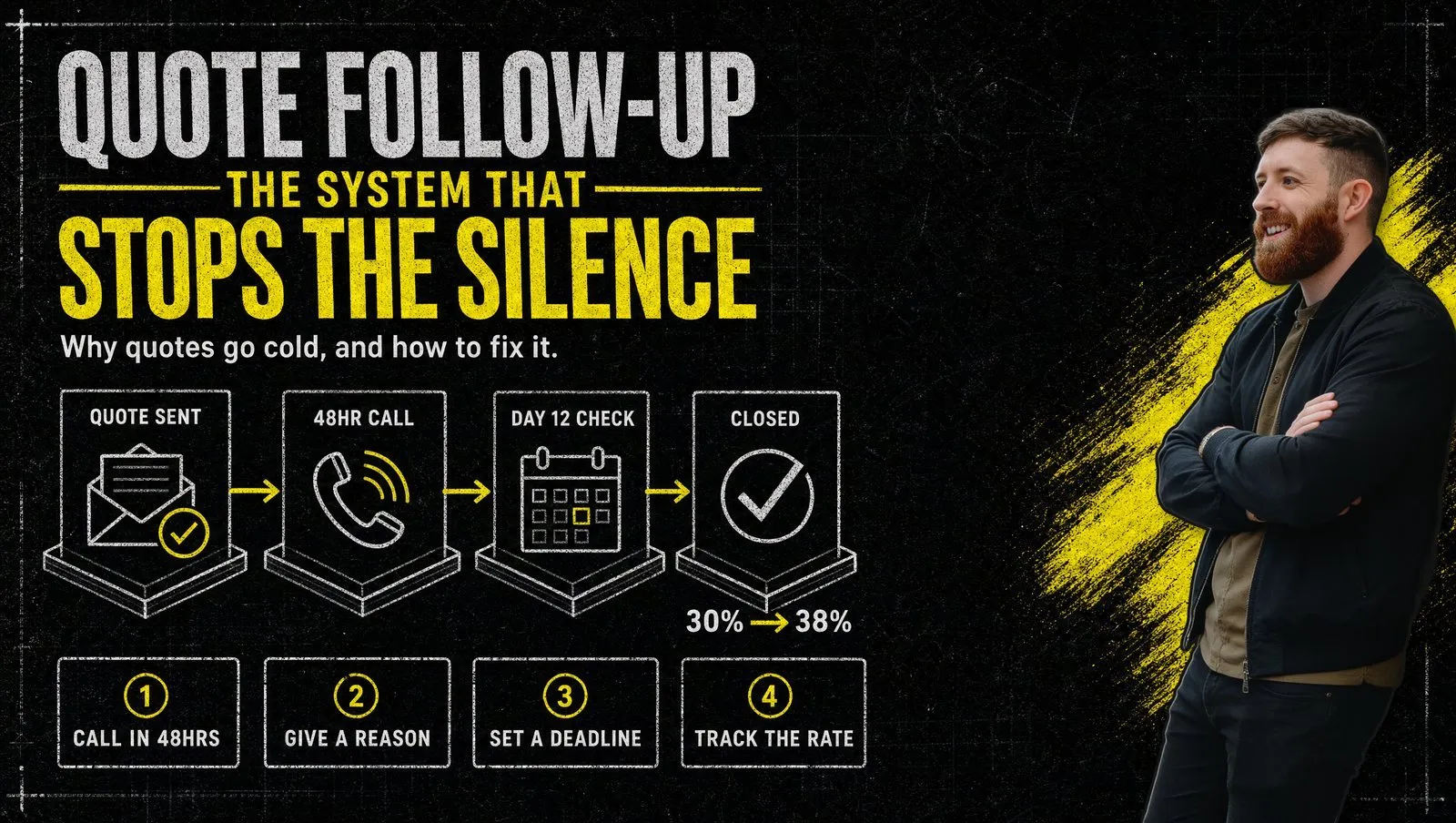
None of this needs a sales team. It needs a process that runs whether or not you remember to run it. This is the structure we build into every Scale and Signature system at Codebreak.
1. A quote sent creates a task, not a filed email
The moment a quote goes out, it goes into a pipeline with a follow-up date attached automatically, not into "sent items" where it quietly disappears. If a quote doesn't have a next action and a date, it isn't being followed up. It's just been sent.
2. The 48-hour call, not the fortnight-later email
Call within two working days to check the quote arrived and answer any questions. Not to ask "have you decided", to ask "did that make sense, and is there anything you want me to run through." Most objections and hesitations surface here, while they're still cheap to deal with. Leave it two weeks and whatever doubt they had has already hardened into "I'll just go with the other one."
3. A reason to reply that isn't "just checking in"
"Any update on this?" gives the prospect nothing to respond to. A message that references something specific from the survey does: "Thinking about the drainage we discussed on the patio, wanted to flag we can start that in the next fortnight if it's useful to know." That's a reason to reply, not a nudge to feel guilty about not replying.
4. A real deadline, not a fake one
Prices held for 30 days, and materials or start dates booked on a first-come basis, are genuine reasons to decide now rather than "at some point." Don't invent urgency that isn't true. Use urgency that already exists, your diary, your supplier prices, your availability, and say it plainly.
5. The close-or-park conversation
Somewhere around day 10 to 14, get a straight answer. Not another chase, a direct question: are you looking to go ahead, do you need anything changed, or has the job gone on hold. A "no" you get in week two is more useful than a "maybe" you're still guessing at in month two, because it frees you to stop chasing and put the effort where it'll convert.
6. Track quote-to-close like you track cost per lead
Most service businesses know their cost per lead to the penny and have no idea what percentage of quotes actually close. Put both numbers on the same weekly sheet. When you can see close rate move as you tighten the follow-up, the "we just need more leads" conversation usually changes into "we need to close more of what we've already got."
Where Codebreak fits
We build and run marketing systems for owner-led UK service businesses doing £750k to £5m. Getting the enquiry is one part of that. Turning a quote into a signed job is the part that actually pays for the marketing. Our Scale and Signature systems build the pipeline, the follow-up sequence and the reporting that tracks a lead all the way from first enquiry to closed job, not just to a quote sent and forgotten. Over £400m of trackable client sales have come through that approach, tracked properly, not estimated.
If you're quoting good jobs and still not winning enough of them, the leak is rarely your pricing. Book a free strategy call and we'll look at your quote-to-close rate and tell you straight where the jobs are actually going.
Frequently asked questions
How do you follow up on a quote without sounding pushy?
Reference something specific from the survey or conversation rather than asking for a decision. A message like "thinking about the drainage we discussed on the patio, wanted to flag we can start in the next fortnight" gives the prospect something to respond to. A generic "just checking in" reads as a nudge and usually gets ignored.
How long should you wait before following up on a quote?
Call within 48 hours to confirm the quote arrived and answer questions, then check in again around day 10 to 14 for a straight answer. Waiting two weeks for the first contact gives any hesitation time to harden into a no. A follow-up date should be set automatically the moment the quote goes out, not left to memory.
What should a quote follow-up email say?
Reference a specific detail from the job, not a generic status check. State a genuine reason to decide now, such as a price hold date or limited start availability, and ask a direct question rather than leaving the door open indefinitely. Avoid "just checking in", it gives the reader nothing to reply to.
Why do customers go quiet after receiving a quote?
Usually because life got in the way, not because the price was wrong. The quote gets read once, filed, and forgotten under everything else that week. Without a follow-up call or a reason to decide by a certain date, there's no prompt to come back to it, and the job often ends up going to whoever chases it properly.
How do you write a quote follow-up email?
Keep it short, reference a specific point from the survey rather than the quote in general, and give a real reason to reply, a start-date deadline, a price hold, or a direct question about whether anything needs changing. Send the first one within 48 hours and a second, direct one around day 10 to 14 if you haven't heard back.