
You hit £1m and it should have felt like arrival. Instead the phone rings less predictably than it did at £600k, you're still the one closing half the deals, and last month's quiet patch had you doing mental maths on payroll again. Nothing about this is a delivery problem. It's a marketing problem, and it's the same one for almost every founder-led service business that gets here.
Most advice on how to scale a small business covers hiring, delegation and cash flow. All true, none of it explains why the enquiries dried up the month you needed them most. For a service business specifically, the honest answer is this: scaling past £1m almost always breaks the marketing that got you there, not the delivery. Referrals and word of mouth stop being enough on their own, and most founders try to plug the gap with more of their own hours rather than a system. The fix is building repeatable lead generation before growth forces the issue, not after.
Here's what actually changes in your marketing at each stage past £1m, and what to fix first.
The marketing that got you to £1m won't get you to £2m
Referrals and reputation are a brilliant growth engine right up until they aren't. They got you from nothing to something because they're free, they convert well, and they don't need a strategy. The problem is they're uncontrollable. You can't turn a dial and get more of them this month because last month was quiet.
Take a landscaping business owner we'll call Derek, turning over £1.1m. Every enquiry for the last four years has come from a past client or a mate in the trade. It's worked. But Derek can't tell you how many enquiries he'll get in March, and neither can you if you're in the same position. That's not a growth strategy. That's hope with a good track record.
The businesses that break through £1m are the ones that add a second engine before the first one splutters, not after. Not instead of referrals. Alongside them.
What actually breaks first
It's rarely one dramatic failure. It's three small ones, usually in this order.
- Feast or famine gets worse, not better. More revenue should mean more stability. Instead the swings get bigger, because you're now relying on a slightly bigger network with the same unpredictable timing.
- You're still the best salesperson, which caps everything. If growth depends on your hours in a sales conversation, growth is capped at your calendar. That's true at £750k and it's still true at £3m if nobody fixes it.
- Nobody can tell you what it costs to win a customer. Ask a founder at this stage what their cost per lead is and you'll usually get a shrug. Without that number, every decision about spending more on marketing is a guess dressed up as a strategy.
Any one of these will slow you down. Left alone, they compound.
How to scale a small business without losing what makes it work
None of this means abandoning what built the business. It means adding a system that produces enquiries on demand, running quietly next to the referrals, not replacing them.
In practice that's paid traffic (Google, Meta, or both) pointed at a landing page built to convert, followed up automatically so a lead doesn't go cold because nobody called them back for four days. It's not complicated. It's just deliberate, where referrals are accidental.
The founders who get this wrong tend to make one of two mistakes. They either try to build it themselves on top of an already full week, and it limps along at half effort. Or they hire a generalist marketing agency that reports on clicks and impressions and can't tell them what a lead actually cost to produce. Both waste a year.
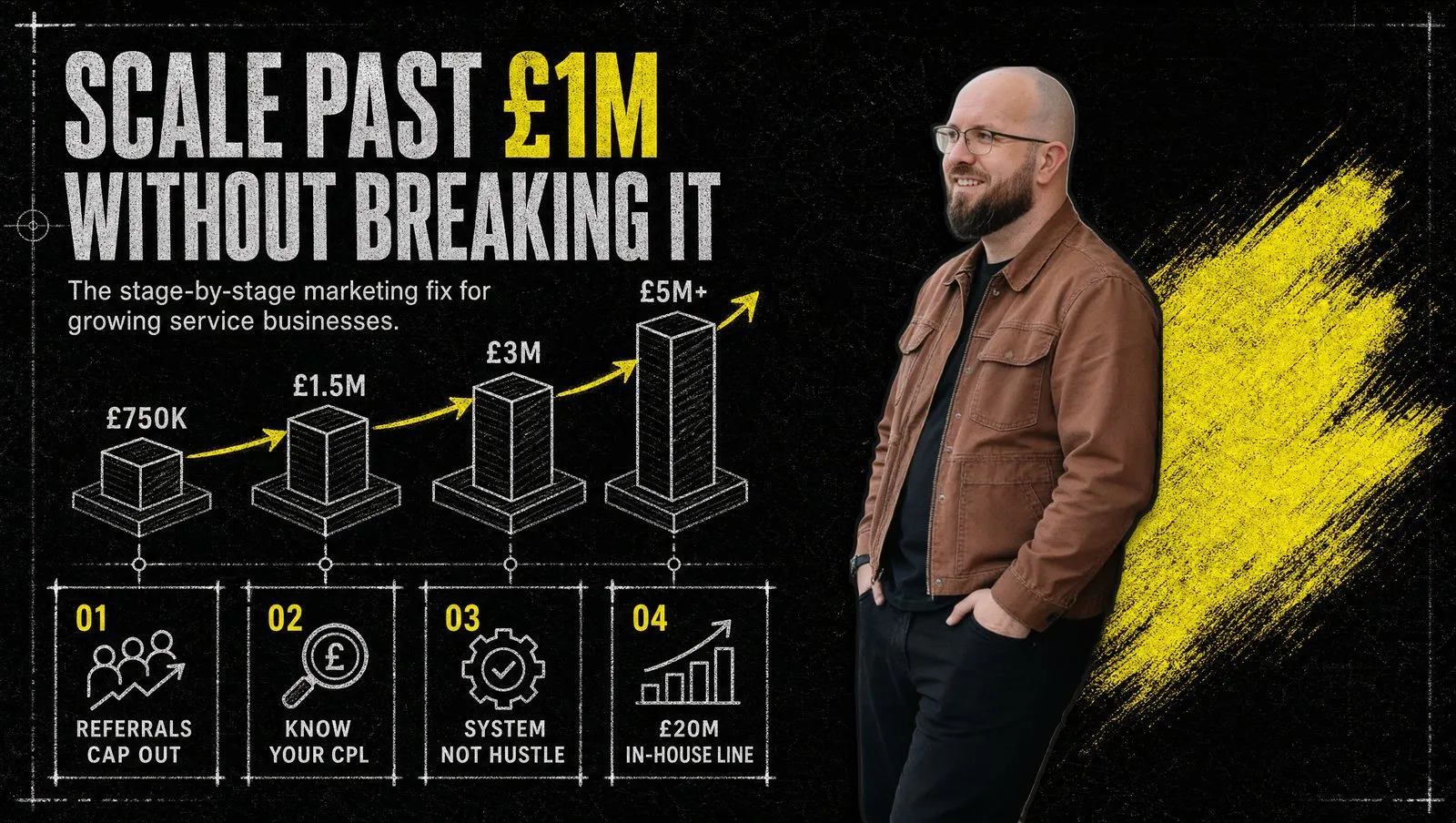
What changes at each stage between £750k and £5m+
The marketing a business needs isn't static. It should mature as revenue does.
£750k to £1.5m: prove the channel
The job here is narrow. One or two paid channels, a landing page that actually converts, and enough follow-up that a lead doesn't slip through the cracks. The goal isn't volume. It's proving you can generate a lead for a known, repeatable cost.
£1m to £3m: build the system
Once the channel works, this is where most businesses need it to run without founder involvement. That means multi-step follow-up across email, SMS or WhatsApp, proper conversion tracking, and weekly numbers you can actually read. This is also the stage where a lot of founders start asking whether they should hire a marketing manager instead. It's worth working through that decision properly rather than guessing, and we've written a full breakdown of what a marketing manager really costs versus a fractional team, because the maths surprises most people.
£3m to £5m+: add authority alongside paid
Paid traffic still does the heavy lifting, but this is where SEO, answer engine optimisation and genuine authority content start paying off, because you've got the budget and the case studies to make them worth doing properly. It's additive, not a replacement.
Worth saying clearly: you do not need an in-house marketing department at any of these stages. That call rarely makes sense until turnover clears roughly £20m. Below that, the maths favours a fractional or done-for-you model almost every time, which is exactly why so many founders get this decision wrong before they've done the sums.
The one number to check before you spend another pound
Before increasing marketing spend at any stage, know your cost per lead and what a customer is actually worth to you over their lifetime. If a customer is worth £8,000 to your business over time, paying £150 to win one isn't a cost. It's the best trade you'll make all week. But you can't make that call blind, and most businesses at this stage still are.
Work out cost per lead. Work out lifetime value. Then decide how many customers you actually want this quarter. That's not a growth hack. That's just doing the maths that referrals never made you do.
Where Codebreak fits
We build done-for-you marketing systems for exactly this stage: founder-led UK service businesses turning over £750k to £5m+ who've outgrown referrals but aren't ready for, or don't need, an in-house team. Over £400m in trackable client sales and £45m+ in ad spend managed comes from running this same playbook, adjusted to what each business actually needs at its stage rather than a one-size template.
If you want a straight answer on whether now's the time to add a second engine to your marketing, or what it would cost to do properly, book a free strategy call and we'll tell you plainly, numbers included.
Frequently asked questions
How do I know it's actually time to scale my service business, not just work harder?
If you're turning down work, if your team has spare capacity you're not filling, or if a quiet referral month puts real pressure on cash flow, that's the business telling you the bottleneck is enquiries, not delivery. That's the point to build a second lead source, not push harder on the first.
What's the difference between scaling and just growing revenue?
Growing revenue can mean working more hours or taking on more risk to earn more. Scaling means revenue goes up without you personally being the constraint. If growth depends on you being in every sales call, you're growing. You're not scaling yet.
How to scale a small business without hiring a full marketing team?
Most businesses between £750k and £5m don't need to hire anyone in-house to do this. A fractional or done-for-you marketing partner can run paid ads, landing pages and follow-up for a fraction of the cost of even one full-time hire, and can be live within weeks rather than the two to three months it typically takes to recruit and onboard a marketing manager.
What's a realistic marketing budget once you're scaling past £1m?
Most businesses at this stage start with £2,000 to £3,000 a month in ad spend, on top of the cost of running the system itself. The exact number depends on your margins and what a customer is worth to you, which is exactly why knowing your numbers matters more than picking a round figure.
Do I need to change marketing agency as my business scales?
Not necessarily, but you do need to check the agency you're with can actually operate at the next stage. An agency that's only ever run one static campaign for you at £800k may not have the systems for multi-step follow-up and proper attribution at £2m. Ask them plainly what changes in their approach as your revenue grows. If the answer is vague, that's your answer.