
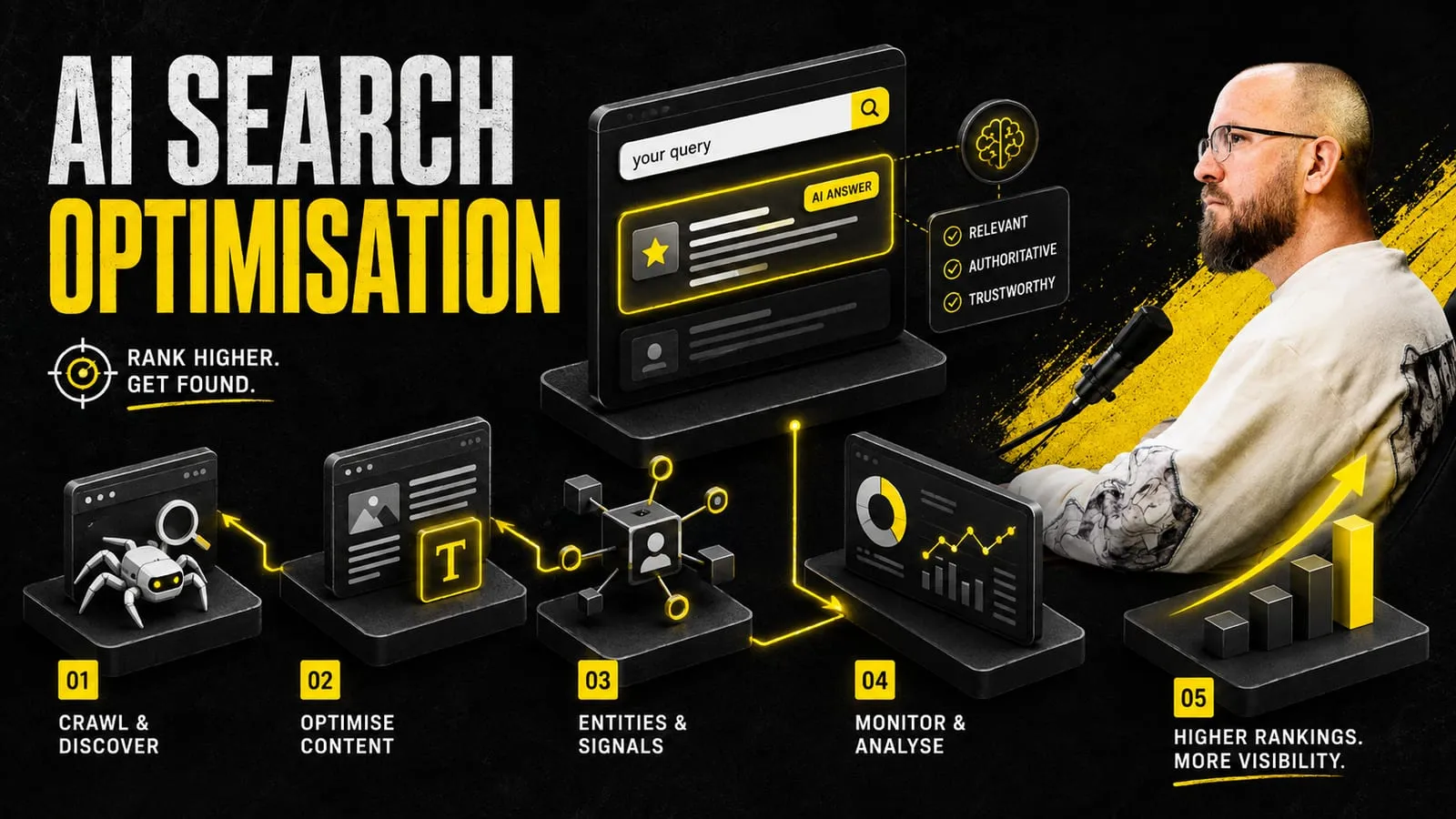
AI search optimisation is changing which businesses get cited by ChatGPT, Perplexity and Google's AI Overviews, and the pattern is consistent. A prospective client asks ChatGPT "best cosmetic dentist in Manchester" or searches Perplexity for "how to choose a roofing contractor", and an AI-generated answer appears, complete with specific business names, credentials and recommendations. The businesses getting cited aren't always the ones at the top of Google. They're the ones whose content is structured for how AI retrieval systems work.
This discipline has two overlapping names in practice: AEO (Answer Engine Optimisation) focuses on being chosen as the direct answer to a specific question; GEO (Generative Engine Optimisation) focuses on making your brand and content citable within broader AI-generated responses. At Codebreak, both are integrated into the performance marketing services we offer to owner-led service businesses, because search behaviour has shifted enough that overlooking either can reduce AI-driven visibility and may limit potential pipeline.
This guide covers the core principles of AI search optimisation: how to audit your site, implement the right changes, and track whether AI engines are actually citing you.
How AI engines decide what to cite
AI search tools like Perplexity and Google's AI Overviews use a process called retrieval-augmented generation. They pull from indexed web content, then use a language model to synthesise a response from the most relevant, clearly structured sources they find.
The key distinction from traditional search is this: these systems don't rank pages in the conventional sense. They extract content that is clear, authoritative and structured enough to quote accurately. For a service business, this changes the priority. Your page doesn't need to rank first; it needs to be the clearest, most directly useful answer to a specific question. A well-structured page on a third-page domain can outperform a poorly structured page that ranks number one.
Why entity clarity matters more than it used to
AI models rely heavily on entity signals to decide whether to trust and cite a source. Entity signals are the consistent signals across your site and the wider web that establish who you are, what you do and where you operate. If your business name, service area and areas of expertise aren't clearly and consistently communicated across your content and third-party mentions, AI engines treat you as an unknown quantity.
Traditional SEO authority and AI discoverability diverge here: a site can rank reasonably well while remaining effectively invisible to AI retrieval systems because its entity signals are weak or inconsistent.
The relationship between good SEO and AI visibility
Google's own published position is straightforward: AI search visibility is largely a downstream effect of solid SEO, distinctive content and strong technical foundations. There are no AI-only hacks, no special files or proprietary markup required. What does make a measurable difference is a set of specific optimisations within the broader SEO framework: content structure, answer-block formatting, schema implementation and entity building. The rest of this guide covers those specifics.
AI search optimisation: content formats AI systems prefer to extract
AI systems consistently favour content that is easy to extract in small, self-contained chunks. Long, dense paragraphs that bury answers in supporting detail are systematically skipped. The formats that appear most frequently in AI-generated answers, drawn from observed AI extraction patterns and Google's guidance on content structure, include question-based headings, direct answer blocks, FAQ-style Q&A pairs, numbered step content and HTML comparison tables.
Writing answer blocks for AI search optimisation
The answer block approach is straightforward to implement once you understand the logic. Each H2 or H3 section should open with a direct, declarative sentence that answers the implied question in the heading. Follow it with two or three supporting sentences. Keeping the whole block to roughly 40 to 75 words allows it to read as a self-contained unit that can be quoted without modification, a range consistent with how AI systems tend to extract and surface featured snippets.
This isn't about keyword repetition; it's about giving AI retrieval systems a clean, complete chunk that fully answers one question before moving to the next.
FAQs, HowTo content and comparison tables
FAQPage-style Q&A pairs, numbered HowTo content and HTML tables each appear with notable frequency in AI-extracted answers, for distinct reasons:
- FAQ-style Q&A pairs map directly to how AI answer generation works, because the question and answer are already separated into discrete units.
- Numbered HowTo content is easy for AI to extract and rephrase as steps, particularly for procedural queries.
- HTML tables work well for comparisons and data-heavy content where multiple attributes need to be presented side by side.
Each of these formats also has a corresponding schema markup type. Using matching visible structure and schema reinforces the same structural signals to AI systems, though schema alone is not a guarantee of citation.
Structured data that signals your content to AI
Structured data doesn't guarantee AI citations, but it makes your content significantly easier for AI retrieval systems to interpret correctly. For service businesses, the most valuable schema types depend on content type and the signals each one sends to AI systems.
The schema types that matter most for service businesses
- Article or BlogPosting should go on almost all editorial and guide content. It gives AI a clear content type plus authorship, publication dates and publisher context.
- FAQPage is a high-priority type for pages with genuine Q&A blocks, because the question-and-answer structure maps directly to AI summary formats.
- HowTo markup applies to step-by-step guide content, and its structured steps are easy for AI to extract.
- Organisation markup, particularly with the sameAs property, establishes entity identity by linking your business to authoritative external profiles: your Google Business Profile, industry directories and any relevant third-party listings.
Key properties that signal authority and freshness
Within these schema types, specific properties carry disproportionate weight. Google's structured data documentation consistently flags the sameAs property on Organisation and Person markup as high-leverage: it connects your entity to corroborating external identities, helping AI systems resolve who you are with confidence. The datePublished and dateModified properties are the main freshness signals; dateModified in particular can affect citation eligibility for time-sensitive content. Author and publisher attribution on Article markup signals credibility.
One critical rule: structured data works best when it accurately describes the visible page content. AI systems cross-reference markup against what a reader actually sees, and mismatches reduce trust rather than increase it.
Technical barriers that silently block AI access
A number of service business websites are inadvertently blocking AI crawlers from accessing their content entirely. Unlike a rankings drop, this kind of invisibility has no obvious symptom; you simply don't appear. The main blockers each operate differently, and several can appear as accidental side effects of technical configurations rather than deliberate choices.
Crawl access: robots.txt, directives and JavaScript rendering
- Robots.txt rules can disallow AI crawlers from specific paths. User agents to check for include GPTBot, OAI-SearchBot, ClaudeBot and PerplexityBot. Verify these against current vendor documentation from OpenAI, Anthropic and Perplexity, as the exact strings can change.
- NoAI and nosnippet meta directives explicitly instruct crawlers not to use content for AI purposes and can be buried in a page's header without a developer having flagged them.
- JavaScript-rendered content is often invisible to crawlers that only fetch raw HTML, which is a common issue with page-builder-heavy sites.
- Paywalls or login walls block access entirely, even for content that isn't intentionally protected.
Running a quick AI discoverability audit
You can complete a basic audit without developer access:
- Check your robots.txt file for overly broad disallow rules that might catch AI crawlers alongside others you intended to block.
- Confirm that key service and content pages are not set to noindex.
- Test how a key page renders without JavaScript using a browser developer tool (most browsers include this in their inspect panel).
- Verify that your site is accessible to external crawlers without authentication requirements.
For any issues you find, a developer will likely need to implement the fix, but identifying them yourself narrows the brief considerably.
Measuring whether AI is actually citing you
Tracking AI citations requires a different measurement approach from organic rankings, but the signals are available if you know where to look. Building a practical tracking stack means combining first-party platform data, direct citation checks and secondary monitoring rather than relying on any single source.
First-party signals: Search Console and direct citation checks
Google Search Console includes a Generative AI performance report showing impressions from pages appearing in AI-powered Search features, including AI Overviews. The initial rollout was UK-based, giving many UK service businesses early access to this data, though availability varies by account, so check Google's current documentation to confirm access for your region. It remains the most direct first-party signal available for Google's AI features.
For Perplexity and ChatGPT, the most reliable method is manual: run the queries your prospective clients are likely asking, check whether your business or content is cited in the answer, and log those checks monthly so you have a baseline to measure against.
Third-party monitoring and server log analysis
Server logs can show AI-related crawler activity if you filter for known user agent strings including GPTBot, OAI-SearchBot, ClaudeBot and PerplexityBot. Brand monitoring tools such as Ahrefs, SEMrush, Brandwatch and Meltwater can catch downstream mentions when AI outputs are quoted or referenced by other sites and publications, useful for tracking zero-click AI citations that never appear as direct traffic. Structured content extraction services like Diffbot can identify when your content appears in AI-surfaced web results.
Treat this as an ongoing monitoring system rather than a one-off audit; AI search behaviour is evolving quickly in 2026, and a monthly cadence will catch shifts that a single snapshot misses.
When professional GEO and AEO management makes sense
AI search optimisation involves content strategy, technical implementation, structured data management, entity building and ongoing measurement. Each individual task is manageable in isolation. The difficulty is doing all of them consistently while still running a service business at scale. Schema maintenance tends to slip first, followed by content cadence. That's where most owners stall.
GEO and AEO in practice mean auditing and restructuring existing content, implementing and maintaining schema markup, building entity authority through off-site signals, and writing answer-block-optimised content at scale. Running a monthly measurement cadence sits across all of it. The discipline is well-defined; the execution requires sustained attention across multiple specialist areas simultaneously.
Codebreak offers managed GEO and AEO services as part of a fully managed marketing system for owner-led service businesses, handling technical implementation, content structuring and citation tracking so business owners don't have to manage it themselves. The same revenue-first framework that governs paid media and conversion-focused web builds applies here: success is measured on leads and enquiries, not on abstract visibility metrics. For service businesses looking to build and maintain AI search presence as part of a wider marketing system, speak to the Codebreak team to discuss whether a managed approach is the right fit for your business.
The framework, summarised
AI search optimisation rewards businesses that publish clear, well-structured, entity-authoritative content, support it with the right schema markup, remove technical access barriers, and track citations consistently. None of the individual steps are out of reach for a service business owner willing to work through the audit and implementation sequence described here.
The challenge is doing all of them together, maintaining them as AI-driven search discovery continues to evolve, and integrating them with the rest of a marketing system that needs to generate measurable revenue. If you want the managed version of this work rather than handling it in-house, speak to the Codebreak team about how GEO and AEO fit into a fully managed performance marketing system built around your revenue targets.
Frequently asked questions
What is AI search optimisation?
AI search optimisation is the practice of structuring your website content, schema markup and entity signals so that AI search tools like ChatGPT, Perplexity and Google's AI Overviews can find, trust and cite your business in their generated answers. It covers two overlapping disciplines: AEO (Answer Engine Optimisation), being chosen as the direct answer to a specific question, and GEO (Generative Engine Optimisation), making your brand citable within broader AI-generated responses.
What is the difference between AEO and GEO?
AEO (Answer Engine Optimisation) focuses on being chosen as the direct answer to a specific question, for example through answer blocks and FAQ content that AI systems can quote without modification. GEO (Generative Engine Optimisation) focuses on making your brand and content citable within broader AI-generated responses, which leans more on entity signals, authority and consistent third-party mentions. In practice the two overlap heavily and are best implemented together.
Does schema markup guarantee AI citations?
No. Structured data doesn't guarantee AI citations, but it makes your content significantly easier for AI retrieval systems to interpret correctly. The highest-value types for service businesses are Article or BlogPosting on editorial content, FAQPage on genuine Q&A blocks, HowTo on step-by-step guides, and Organisation markup with the sameAs property to establish entity identity. Markup must accurately describe the visible page content, because AI systems cross-reference the two and mismatches reduce trust.
Which AI crawlers should I allow in robots.txt?
The main user agents to check for are GPTBot and OAI-SearchBot (OpenAI), ClaudeBot (Anthropic) and PerplexityBot (Perplexity). If your robots.txt disallows these, your content is invisible to those AI engines regardless of how well it is written. Verify the exact strings against current vendor documentation, as they can change, and check that noAI or nosnippet meta directives haven't been added to your pages without your knowledge.
How do I track whether AI engines are citing my business?
Combine three sources. First-party data: Google Search Console includes a Generative AI performance report showing impressions from AI-powered Search features, including AI Overviews. Direct checks: run the queries your prospective clients ask on ChatGPT and Perplexity, and log monthly whether you are cited. Secondary monitoring: filter server logs for AI crawler user agents and use brand monitoring tools to catch downstream mentions. A monthly cadence catches shifts a one-off audit misses.