
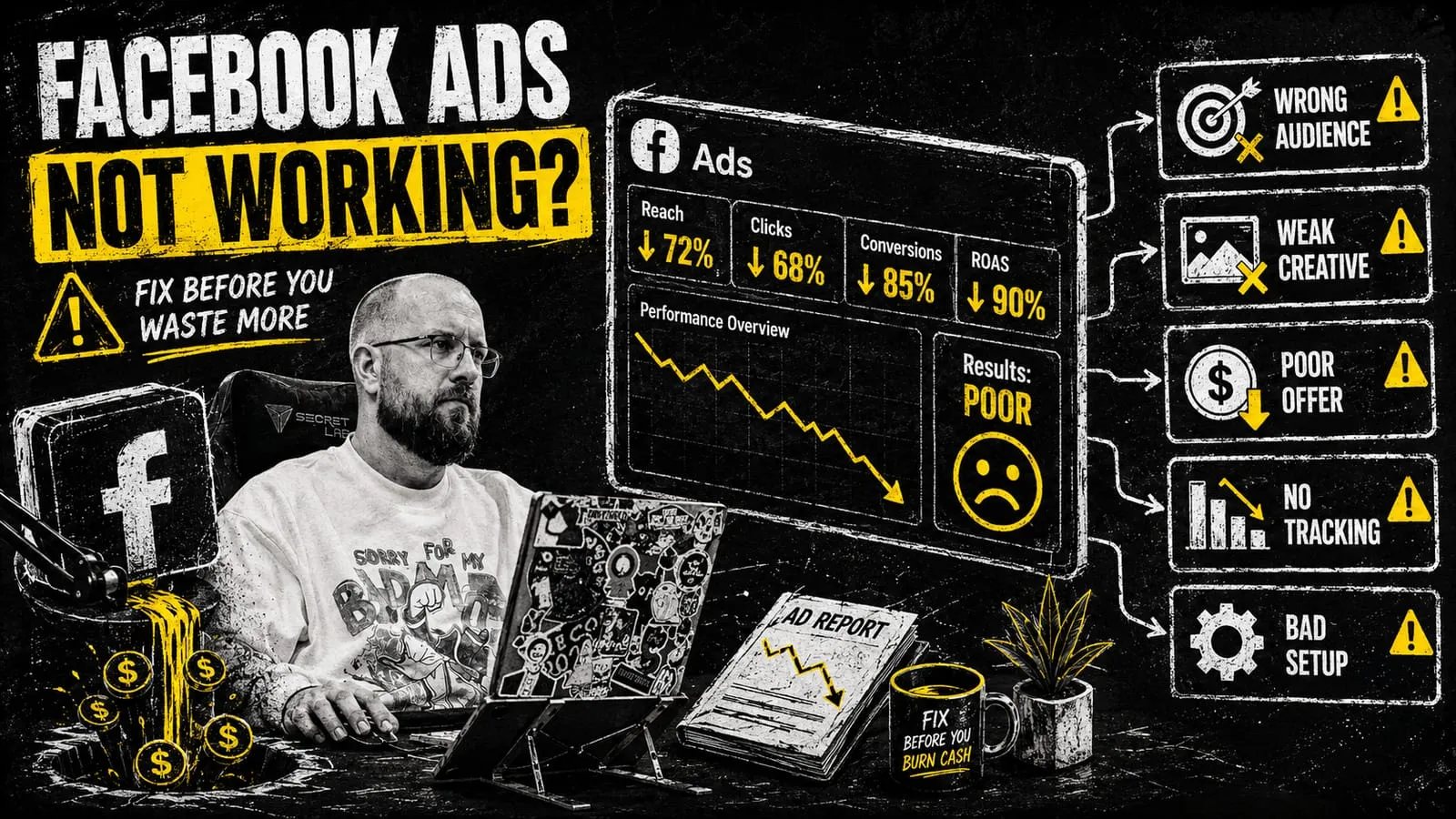
If your Facebook ads are not working, you're not alone, and in most cases, the platform isn't to blame. Service business owners who pause a campaign after a week of silence tend to point the finger at Meta, cut the budget, and move on, often to repeat the same mistakes elsewhere. The platform is rarely the problem. The structure underneath it almost always is.
At Codebreak, we audit paid accounts for service businesses regularly, and the same failure patterns surface almost every time. Not one clean problem, but several stacked on top of each other: a targeting setup that made sense on paper, an offer that works in conversation but falls flat in an ad, and a landing page that wasn't built to convert under paid traffic conditions. Fix one without addressing the others, and delivery improves temporarily before sliding back.
This article is a diagnostic checklist, not a list of generic tips. Some fixes are technical, some are strategic, and most don't require starting from scratch. Work through them in order and you'll either find the root cause or eliminate the candidates one by one.
1. Your audience targeting is too narrow or completely wrong
Meta's algorithm needs room to work. For stable, consistent delivery, you need an audience of at least 100,000 people, significantly more if your daily budget exceeds £100. When you layer too many filters on top of each other, demographics, interests, behaviours, custom exclusions, the resulting audience can drop well below the threshold where the algorithm can function reliably. A trades business targeting homeowners aged 45 to 65 within a 10-mile radius who have also expressed interest in DIY seems logical. In practice, it's often too small to generate meaningful delivery at any budget.
Overlapping ad sets compound the problem. When two or more ad sets target the same audience, Meta enters them into the same auction against each other. The result is inflated CPMs, fragmented data, and no clear signal about what's actually working. From Codebreak's analysis of managed accounts, unmanaged audience overlap consistently drives CPMs up by around 30% or more, with cost per acquisition rising substantially in severe cases.
Use the Audience Overlap Tool inside Ads Manager to identify duplicates. If overlap between active ad sets exceeds 20%, consolidate them. Low ad reach on Facebook is frequently a direct consequence of this kind of fragmentation, not a budget problem.
Beyond size and overlap, there's a targeting temperature problem most service businesses overlook entirely. Running a conversion-focused ad to a cold audience that has never encountered your business asks for a significant commitment too early. Cold traffic needs a different message and a different objective. Retargeting warm audiences with conversion campaigns makes sense. Cold prospecting with the same creative does not.
2. The offer isn't built for paid traffic
Paid social traffic is interruptive. Someone scrolling through their feed wasn't looking for you, and your offer has very little time, a matter of seconds, to give them a reason to stop. "Contact us for a free quote" doesn't do that. It asks for commitment before trust has been established, and it gives the viewer no specific reason to act now rather than later, which in practice means never.
A useful diagnostic question: would a complete stranger act on this offer within moments of seeing it for the first time, with no prior knowledge of your business? If the honest answer is no, the offer needs restructuring. Consider what frictionless action you're actually asking for, and whether it's proportionate to the trust level of someone who's just seen your ad.
For higher-ticket service businesses, dental practices, roofing companies, professional services firms, discounting is rarely the answer. It attracts price-sensitive buyers and positions the business on cost rather than value. The goal of the offer is to reduce friction, not price. A no-obligation assessment, a fixed-price diagnostic, or a clearly scoped starter package all serve that purpose. They lower the barrier to starting a conversation without devaluing what you actually deliver.
3. Your landing page is where enquiries go to die
Facebook ads not working is often a post-click problem, not a pre-click one. The ad generates the interest; the landing page either capitalises on it or wastes it. If the ad promises a specific outcome and the page opens on a generic homepage or a cluttered contact form, the visitor bounces before reading a single line. The headline on your landing page must directly continue the conversation the ad started. Message match isn't a nice-to-have; it's the mechanism that keeps the visitor engaged long enough to enquire.
Industry benchmarks for service-based landing pages suggest average conversion rates of roughly 6.5% to 11%, depending on vertical. Dental and healthcare campaigns tend to sit at the higher end; trades and professional services at 6.5% to 10% when well optimised. Pages that aren't purpose-built for paid traffic typically convert at a fraction of those figures.
The structural differences are straightforward. A conversion-first page has one clear action, not five navigation links and a blog section. Social proof sits close to the call to action, not buried in a footer. And it loads as quickly as possible on mobile, slow-loading pages lose a meaningful share of visitors before they've read anything.
A well-optimised landing page can significantly increase your enquiry rate without touching the ad campaign at all. That's not an argument for ignoring the ads; it's an argument for treating the page with equal seriousness.
4. Why Facebook ads stop working: technical delivery blockers
Around 7% of new creatives are flagged by Meta's automated review system, often incorrectly. A Facebook ad disapproved by the system is more common than most businesses realise, and for service businesses, the most common triggers include testimonial-style claims, before-and-after implications, and language that touches on health outcomes or financial results.
The fix starts in the Delivery column inside Ads Manager: hover over the status icon to read the specific diagnostic message, then either edit to comply or use the Request Review option. Well-prepared appeals, citing the relevant policy and explaining why the ad complies, succeed at rates between 40% and 60%. Generic appeals succeed less than 20% of the time.
5. Pixel health and budget mechanics
Pixel failures are a quieter but equally damaging problem. If your Meta Pixel isn't firing correctly, the algorithm is optimising without information, it can't find the users most likely to convert because it doesn't know what a conversion looks like. Use the Test Events tool inside Meta Events Manager to verify both browser and server events in real time. Check whether the events include the essential fields and at least one hashed user data field. If your campaign shows a Learning Limited status, you're not generating the 50 conversion events per week Meta needs to exit the learning phase, and that problem won't resolve itself without either increasing budget or shifting to an earlier-funnel event.
Meta ads not spending at expected levels is a separate but related issue: as a baseline, set your daily budget at 5 to 10 times your target cost per lead. If your target CPL is £50, a £30 daily budget cannot compete in most service business auctions. Overly restrictive cost caps signal to the algorithm that it can barely enter any auction, resulting in minimal or zero delivery. Temporarily switching to Lowest Cost bidding lets you test whether the campaign can spend before reintroducing caps incrementally.
Ad account restrictions on Meta can also halt delivery entirely, always check account status and billing health before diagnosing creative or audience issues.
6. You're measuring the wrong things and drawing the wrong conclusions
A campaign showing strong click-through rates and low CPMs looks healthy on the surface. If it's generating zero qualified enquiries, it's failing. These two outcomes are not in conflict; they happen regularly. When Facebook ads aren't delivering revenue, that's a fundamentally different problem from Facebook ads not delivering impressions, and most service business owners conflate them because the metrics inside Ads Manager are designed to make the platform look productive regardless of what's actually happening downstream.
The metrics that matter for service businesses are cost per qualified lead, lead-to-appointment rate, and cost per confirmed job or client. Frequency, reach, and CPM are useful diagnostic signals when something is wrong; they are not success metrics.
The gap between ad performance and business performance typically sits at the form submission: most businesses know their click data and nothing beyond it. Connecting ad data to CRM or booking data closes the attribution loop and produces the only number that actually answers the question: is this campaign generating more revenue than it costs to run?
7. When fixing individual parts isn't moving the needle
Most underperforming Facebook ad accounts have multiple failure points working against each other simultaneously. A weak offer sends the wrong message. A mismatched audience delivers it to the wrong people. A non-converting landing page wastes what little interest the ad generated. Fixing creative alone, the most common default response, won't rescue a campaign built on the wrong audience or sending traffic to a page that wasn't designed to convert. The individual parts interact, and patching one without addressing the others produces temporary improvements at best.
The real question isn't which creative to test next. It's whether the entire system is built to turn ad spend into revenue. That means reviewing account structure, audience construction, offer clarity, landing page performance, pixel health, and attribution setup together, not in isolation.
This is the approach Codebreak takes with every underperforming paid account. The goal isn't a report on what's broken; it's rebuilding the paid system so that every pound spent has a measurable path to a qualified enquiry. For established service businesses, the cost of a broken paid media system, in missed enquiries and wasted budget, is routinely greater than the cost of fixing it properly.
The diagnostic order when your Facebook ads stop working
When your Facebook ads are not working, it's rarely one clean problem. Each layer can mask or compound the one beneath it, so check them in this order:
- Delivery status and billing health inside Ads Manager. A restricted ad account on Meta or a payment failure will stop spend entirely before any other variable matters.
- Audience size and overlap: at least 100,000 people, under 20% overlap between active ad sets.
- Offer structure: would a stranger act on it within seconds of first seeing it?
- Landing page experience: message match with the ad, one clear action, fast on mobile.
- Technical delivery: ad review flags, pixel health, and budget mechanics.
- Measurement: cost per qualified lead and cost per confirmed job, not clicks and CPMs.
If you've worked through this list and still can't isolate the problem, the issue is likely structural rather than surface-level. A fresh set of eyes on the full system is the fastest route to finding it. Codebreak's paid media audit is built specifically for that: a systematic review of every component of your paid system, with clear recommendations on what to fix, in what order, and why. And if the channel mix itself is in question, our guide to the best paid advertising strategies for service businesses in 2026 covers where Facebook should sit alongside Google Search and LSAs.
If you want a clear picture of what's actually holding your campaigns back, get in touch with the team at Codebreak.
Frequently asked questions
Why are my Facebook ads not working?
It's rarely the platform and rarely one clean problem. The failure points that surface most often in service business ad accounts are audience targeting that's too narrow or overlapping, an offer that isn't built for interruptive paid traffic, a landing page that doesn't convert, technical blockers such as ad disapprovals, pixel failures and underpowered budgets, and measuring platform metrics instead of revenue. Check delivery status and billing first, then work through audience, offer, landing page, technical delivery and measurement in that order.
How big should a Facebook ads audience be?
For stable, consistent delivery you need an audience of at least 100,000 people, and significantly more if your daily budget exceeds £100. Layering too many filters, demographics, interests, behaviours and exclusions can shrink the audience below the threshold where Meta's algorithm can function reliably. If overlap between active ad sets exceeds 20%, consolidate them, because overlapping ad sets bid against each other and inflate CPMs.
Why was my Facebook ad disapproved?
Around 7% of new creatives are flagged by Meta's automated review system, often incorrectly. For service businesses the most common triggers are testimonial-style claims, before-and-after implications, and language touching on health outcomes or financial results. Read the specific diagnostic in the Delivery column inside Ads Manager, then either edit to comply or use Request Review. Appeals that cite the relevant policy and explain why the ad complies succeed at rates between 40% and 60%; generic appeals succeed less than 20% of the time.
How much should I spend on Facebook ads?
As a baseline, set your daily budget at 5 to 10 times your target cost per lead. If your target CPL is £50, a £30 daily budget cannot compete in most service business auctions. A Learning Limited status means you aren't generating the 50 conversion events per week Meta needs to exit the learning phase, which won't resolve without more budget or optimising for an earlier-funnel event.
What conversion rate should a service business landing page achieve?
Industry benchmarks for service-based landing pages suggest average conversion rates of roughly 6.5% to 11% depending on vertical, with dental and healthcare at the higher end and trades and professional services at 6.5% to 10% when well optimised. Pages that aren't purpose-built for paid traffic typically convert at a fraction of those figures, so match the page headline to the ad, keep one clear action, and make it fast on mobile.