
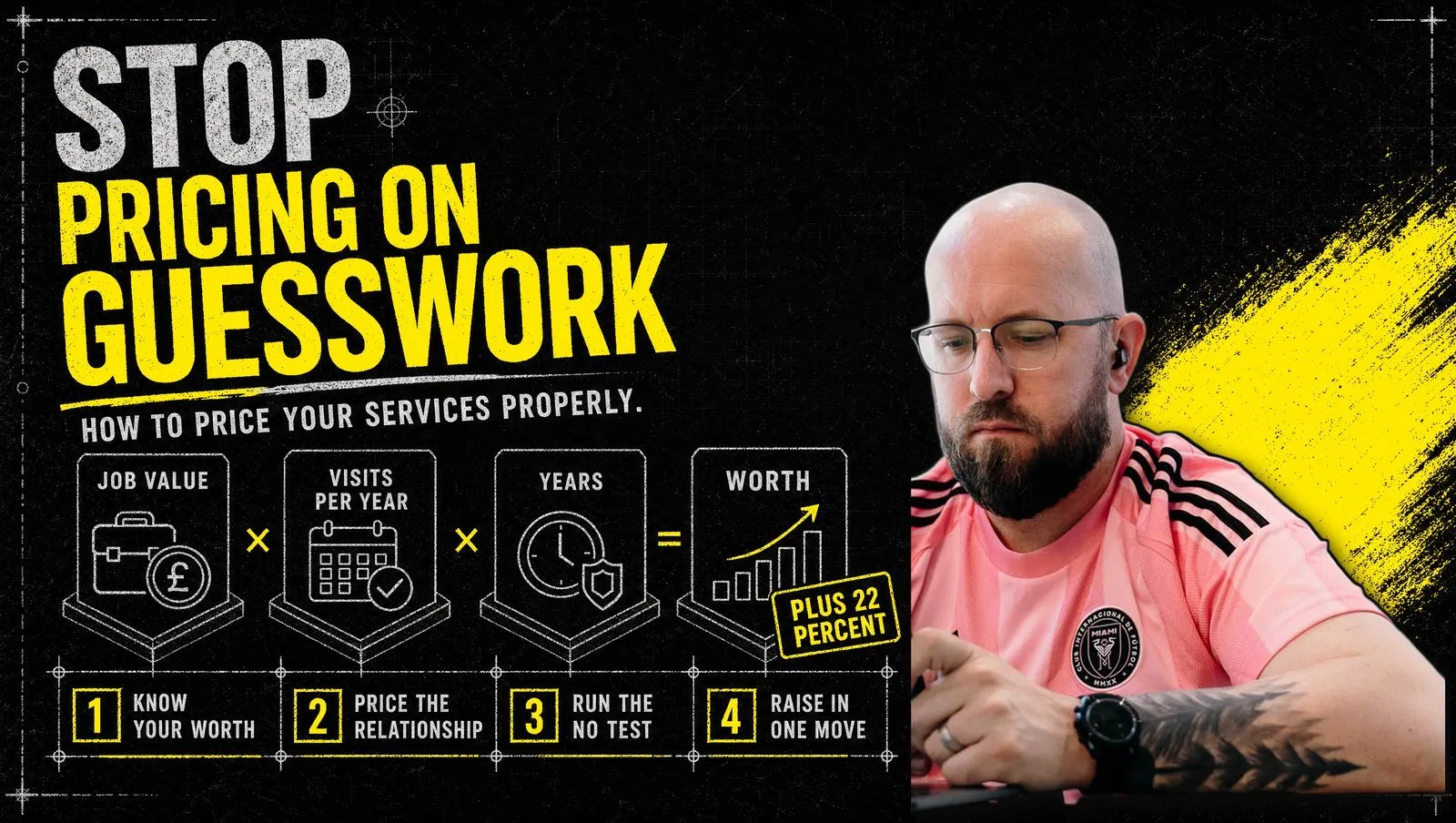
How you price your services should come from what a customer is worth to your business over time, not from what one job costs you to deliver. Work out your average job value, how many times a customer buys in a year, and how long they stick with you. Multiply the three. That number is your floor, not a guess based on what you think the market will take.
Most service business owners never do this. They price off the back of what they think customers will pay, what the last competitor charged, or what felt comfortable the day they wrote their first rate card. Then they wonder why cash flow is tight even when the diary's full.
The question you're actually asking
"How do I price my services" isn't really a pricing question. It's a confidence question. You already know roughly what your time and delivery cost you. What you don't know is whether you're allowed to charge more than that, and that's the bit nobody teaches you.
Here's the short answer: you're allowed to charge whatever a customer worth having is willing to pay for the result they get, not for the hours you put in.
Stop pricing against the quote next door
We had a client, a specialist letting agency in the West Midlands, who priced every management fee a fraction under the big corporate agency up the road. Made sense on paper. Keep the price competitive, win on service.
Problem was, they were also delivering a noticeably better service: faster response times, named property managers, tenants who actually stayed. None of that showed up in the fee. They were subsidising a better product with a worse price.
Once we got them to stop checking competitors' websites before setting their own fees, the number went up 22%. Nobody left. A few landlords didn't even notice.
If your pricing strategy for your service business starts with "what's everyone else charging", you've already capped your own ceiling before you've started.
How to price your services around what customers are worth
This is the bit from Customer Lifetime Value thinking that most small business owners skip. It's simple maths, and it changes the whole conversation with yourself about what you're "allowed" to charge.
- Average value per job or invoice
- How many times a customer buys from you in a year
- How many years a customer typically stays with you
Multiply those three together and you've got what a customer is actually worth to your business, not just what today's invoice says.
A £400 job that repeats four times a year for six years is worth £9,600. Priced like a one-off £400 job, you'll always feel undervalued. Priced like a £9,600 relationship, a 15% increase on day one barely moves the needle on what you're actually earning from that person over time.
We go deeper on the numbers that actually move revenue in our guide to marketing ROI tracking, because pricing and attribution are the same conversation really: know what things are worth, then act on it.
The "no" test
Here's a crude but useful way to check your prices. If nobody has said no to your pricing in the last three months, you're too cheap.
Everyone saying yes isn't a badge of honour. It's a signal you left money on the table for every person who said yes without blinking.
You're aiming for a small, steady trickle of people who think you're a bit too expensive and walk away. Not a flood. A trickle. If it's a flood, you've gone too far the other way. But if there's nothing, test upward.
How to increase your prices without losing clients
Raising prices on new enquiries is easy. Raising them on existing clients is where most business owners bottle it. A few things that actually work:
- Give real notice, in writing, with a reason that isn't "costs have gone up" (that's true for everyone and convinces nobody)
- Lead with what's changed for the better on your side since they signed up, not just the number
- Increase in one clean move rather than a trickle of small rises nobody can track
- Expect a handful of people to leave, and be fine with it, because the ones who stay are now worth more
The clients who leave over a fair, well-communicated increase were rarely your best ones anyway. Chasing the ones who grumble about 10% is a very expensive way to avoid an uncomfortable email.
Where most service businesses leave money on the table
It's rarely the headline price. It's everywhere around it: the upsell nobody offers, the retainer priced like a one-off, the loyal client still on year-one rates five years later, because nobody wanted the awkward conversation.
If you've built the kind of service business where enquiries come in steadily (and if they don't yet, that's a different conversation, one we cover in 5 proven systems to grow a service business fast), pricing is the lever you can pull without spending another pound on marketing.
The bottom line
Price your services against what the customer is worth over time, not what feels comfortable to type into a quote. Expect a few no's. Raise your prices in one clean move, not a slow drip. And stop checking what the agency down the road is charging before you decide what you're worth.
If you want a second pair of eyes on whether your pricing, and the marketing bringing people in to pay it, actually adds up, that's exactly what we do. Book a free strategy call and we'll tell you straight.
Frequently asked questions
How do I price my services without underselling myself?
Work out what a customer is worth to you over their whole relationship with your business, not just one job, then price off that number instead of your hourly cost or a competitor's rate card.
Should I price based on cost or value?
Cost tells you your floor, below which you're losing money. Value, what the result is worth to the customer, tells you your ceiling. Most service businesses price far closer to the floor than they need to.
How often should I review my pricing?
At least once a year, and sooner if nobody has said no to a quote in the last few months, that's a sign your prices are already too low.
How do I raise prices on existing clients without losing them?
Give proper written notice, explain what's improved on your side, raise it in one clean move rather than small repeated bumps, and accept that a few will leave.
What's a quick way to check if my prices are too low?
If every quote you send gets accepted without question, you're underpriced. A healthy pricing strategy produces an occasional, polite no.