
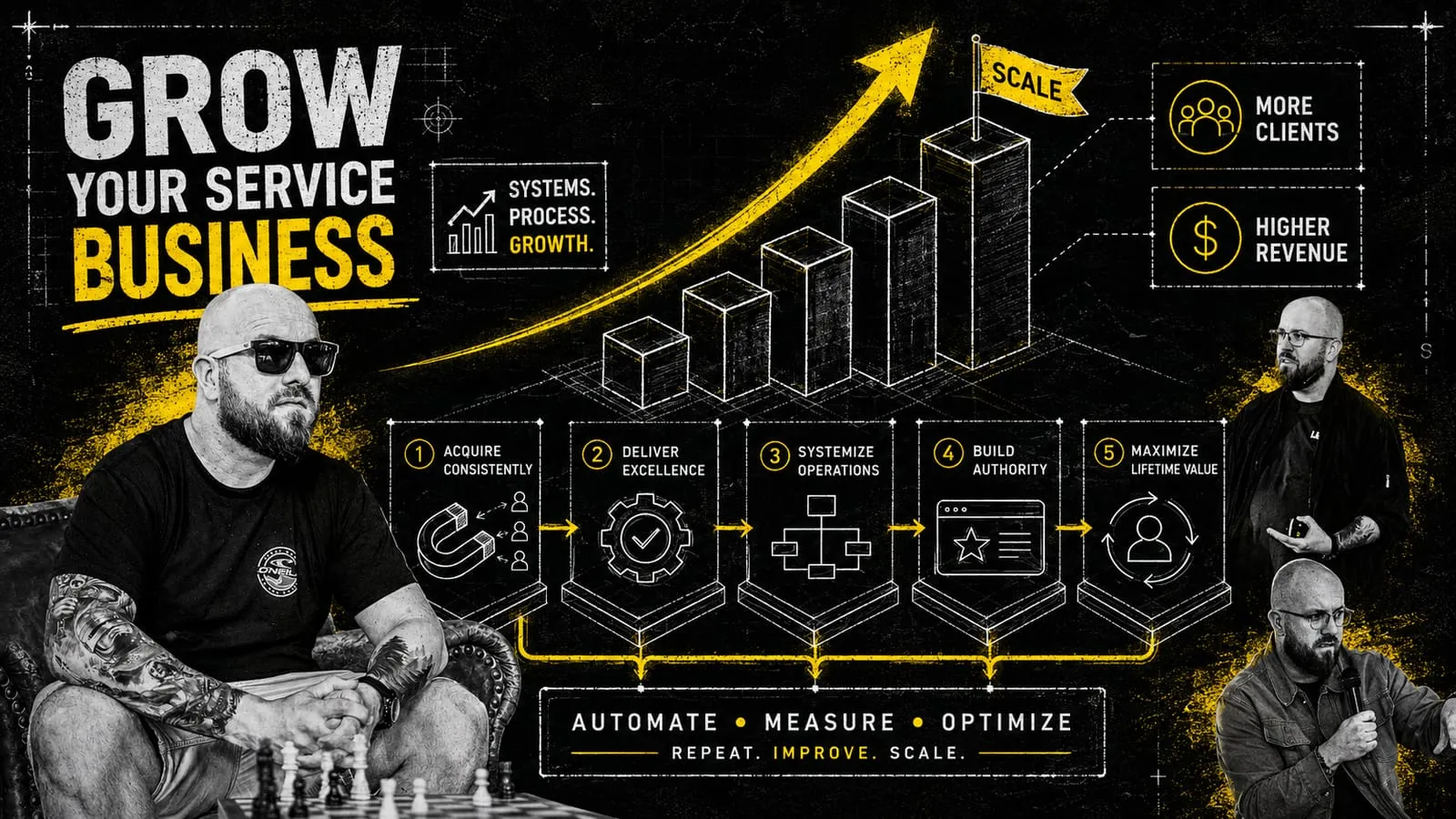
If you're asking how to grow my service business beyond £750k, the answer isn't more hours, it's better systems. Most service business owners at this revenue level aren't short of ambition or work ethic. They're short of a structured approach to lead generation, visibility, and conversion that ties every activity to a single benchmark: revenue. Ad hoc effort produces inconsistent results. A properly built system produces a predictable pipeline.
This is the territory Codebreak has operated in for over a decade, helping established, owner-led service businesses build marketing systems that produce trackable results, not just activity. Below are the five systems that separate service businesses that scale from those that stall, and how each one contributes to a joined-up service business growth strategy.
Why growing past £750k requires a different approach entirely
Many service businesses at this revenue level have grown largely on referrals, word of mouth, and the owner's personal network. That's not a criticism; it's simply how most good service businesses start. The problem is that referral-driven growth is invisible, unpredictable, and almost impossible to accelerate.
The referral trap that caps service business growth
Referrals convert at high rates and arrive with borrowed trust, making them feel like the best lead source available. The issue is volume and timing: you cannot control when they arrive, how many come through each month, or whether they match your ideal client profile. Businesses that rely on referrals alone tend to oscillate between being overwhelmed and being dangerously quiet, which makes forward planning and recruitment decisions far harder to justify. Expanding a service business beyond this ceiling requires replacing that unpredictability with something measurable.
What a structured marketing system looks like vs ad hoc spending
Ad hoc marketing means running a campaign here, trying SEO there, and boosting a post when things go quiet. It produces inconsistent results and makes it impossible to understand what's working. A proper system has defined channels, measurable inputs and outputs, and a clear cost-per-acquisition target. Every tactic connects to a revenue number, not an impression count.
System 1: Paid media to grow your service business with a predictable enquiry pipeline
Paid media, when built correctly, is the fastest lever available to anyone looking to grow a service-based business quickly. It generates lead volume immediately and allows precise targeting by location, intent, and buyer profile. The key phrase is "built correctly." Many service businesses overspend on broad targeting with no conversion infrastructure behind it, or underspend and never generate enough data to optimise. The goal is a paid media system where every pound spent has a trackable return.
Google Ads vs Meta Ads: which to prioritise first
For service businesses where buyers have active, immediate intent, dental, legal, plumbing, or accountancy, for example, Google Ads should be the first investment. It captures demand that already exists. Industry benchmarks indicate Google Ads delivers around 21% lead-to-sale conversion for local service businesses, with the volume and speed that makes it the right starting point while organic visibility builds momentum. Meta Ads (Facebook and Instagram) are often more useful for awareness and retargeting in longer buying cycles, where you need to reach audiences before they're actively searching, making them a worthwhile second channel rather than the primary one.
How to get more clients for your service business: the conversion layer most businesses skip
Running paid traffic to a generic homepage is one of the most costly mistakes in service business marketing. Every campaign needs a dedicated landing page built around a single action, with copy and structure aligned to the search intent that triggered the click. Beyond the page itself, a structured follow-up sequence, whether email, SMS, or both, is what separates businesses closing a meaningful proportion of their leads from those losing enquiries through slow or absent follow-up. In our experience across UK service clients, businesses with no automated follow-up consistently convert at a fraction of those that have even a basic sequence in place. Many service businesses have no automated follow-up at all, which means they're paying to generate enquiries they never convert.
System 2: Search and AI visibility that compounds over time
Paid media generates immediate leads, but it stops the moment you stop paying. Organic search visibility is the compounding system: it builds authority over time and generates leads at a cost-per-acquisition that decreases year on year. In 2026, this means not just traditional SEO but also optimisation for AI-powered search results, where buyers increasingly get answers before they ever visit a website.
Organic SEO as the highest-converting lead source for service businesses
Industry benchmarks consistently place organic SEO among the highest lead-to-sale conversion sources for local service businesses, outperforming most paid channels. The reasons are straightforward: buyers who find you organically are self-qualified. They've searched for exactly what you offer, read your content, and arrived with context. Building a strong organic presence typically takes six to twelve months of consistent effort before dominant positions are established, but the compounding effect on customer acquisition cost over a two-to-three-year horizon is significant and, at that point, difficult for competitors to replicate quickly.
AEO and GEO: getting found in AI-generated search results
Answer Engine Optimisation (AEO) and Generative Engine Optimisation (GEO) are the newer disciplines required to appear in AI-generated search summaries on tools like ChatGPT, Google's AI Overviews, and Perplexity. Buyers are increasingly receiving service recommendations directly from these tools without clicking through to websites. For service businesses, being cited in those AI responses requires structured content, strong topical authority, and clear entity signals across your entire online presence. Businesses that ignore this layer now will find their organic visibility eroding as AI search adoption accelerates, and rebuilding that ground later costs significantly more than establishing it early.
System 3: A website built to convert visitors, not just impress them
Most service business websites are built to look credible, not to generate enquiries. A credibility-focused website tells visitors who you are and what you do. A conversion-focused website moves visitors toward a specific action: booking a call, requesting a quote, or submitting an enquiry. The structure, copy, page hierarchy, and technical foundation all determine whether a visitor converts or leaves within seconds.
Why most service business websites don't generate consistent leads
Generic service descriptions, weak calls to action, no social proof above the fold, and slow load speeds are the most common conversion killers. Visitors make a decision about your website almost instantly. If they can't immediately see what you do, who you serve, and why you're credible, they leave. For many service businesses, the website is the weakest link in the entire marketing system, even when paid media and SEO are performing well.
The structural elements that turn visits into enquiries
High-converting service business websites share a consistent structure: a clear value proposition in the hero section, specific social proof including verifiable results and client names where possible, a frictionless enquiry path, and trust signals distributed across the page. The copy must speak directly to the buyer's problem and desired outcome. That's a distinct discipline from describing what the service does in abstract terms, and the gap between the two shows up directly in enquiry volume. Pages built around specific buyer intent, with strong internal linking and fast technical performance, consistently outperform generic portfolio-style sites.
System 4: Pricing and packaging that grows revenue per client
Marketing systems bring in more enquiries. Pricing architecture determines how much revenue each of those enquiries is worth. Many service businesses undercharge relative to the value they deliver, particularly those still billing hourly. Restructuring how you price and package your services can materially increase revenue per client without acquiring a single additional lead. That makes it one of the highest-leverage moves available to any owner-led service business, and one that requires no additional marketing budget to implement.
Moving from hourly billing to value-based and retainer models
Hourly billing caps your earning potential and creates constant friction around time-tracking and scope. Value-based pricing sets fees according to the outcomes you deliver, which typically justifies significantly higher price points and removes the adversarial dynamic around hours. Retainer and subscription models add a further layer of predictability: a fixed recurring fee for ongoing service creates reliable monthly revenue that makes forward planning, investment decisions, and staff capacity far easier to manage with confidence.
Tiered packages and the anchoring effect on average transaction value
Offering three service tiers, entry, recommended, and premium, is one of the most evidence-backed revenue growth strategies available to service businesses. The anchoring effect consistently steers buyers toward the middle tier, which should be your highest-volume and best-margin option. Tiered packaging also creates natural upsell paths, meaning existing clients can move upward as their needs grow, rather than requiring you to find entirely new buyers to increase revenue.
System 5: Revenue tracking that tells you what's working and what to cut
You cannot grow a service business by measuring impressions and follower counts. The only metrics that matter during a scaling phase are the ones connected to revenue: what it cost to acquire a client, how much that client is worth over their lifetime, and whether the marketing system is generating more revenue than it costs to run. Everything else is noise that delays the decisions that actually matter.
The four KPIs every scaling service business must track
Four benchmarks determine whether a business is scaling profitably or simply growing its costs:
- Gross margin: target 50 to 70% for most service businesses
- Utilisation rate: target 70 to 80%
- LTV:CAC ratio: minimum 3:1, healthy at 5:1 or above
- Client retention rate: target 75% or above
If CAC is rising faster than average order value, growth should pause until the unit economics are corrected. These four numbers, tracked consistently, tell you more about the health of your business than any dashboard full of channel-level metrics.
Weekly revenue reporting vs monthly vanity metrics
Most agencies report monthly, mostly on metrics that don't connect to revenue. Scaling service businesses need weekly visibility on lead volume, cost-per-enquiry, and pipeline value relative to targets. This frequency catches problems early, before they compound into wasted budget and missed quarters. Ask one question of your reporting structure every week: is the marketing system generating more revenue than it costs to run? If you can't answer it clearly, the reporting isn't doing its job.
How these five systems work together to grow a service business
If you want to grow my service business from £750k toward £5m, the route isn't scattered effort, it's the right systems installed in the right order. Paid media for immediate lead flow. SEO and AI visibility for compounding reach. A website infrastructure that converts. Pricing architecture that increases revenue per client. And KPI tracking that tells you what's actually working. Each system amplifies the others when they're connected and measured against the same revenue benchmark. That's a complete service business growth strategy, not a collection of tactics.
For service business owners who want all five systems built and managed without becoming the marketing manager themselves, Codebreak operates as a fully managed performance marketing partner. Paid media, SEO/AEO/GEO, and conversion-focused website builds are delivered as one integrated system, judged entirely on leads, enquiries, and trackable revenue. No vanity metrics. No monthly reports full of clicks. Just a clear answer to the only question that matters.
If your service business is generating between £750k and £5m in annual turnover and you're ready to replace referral dependency with a predictable pipeline, speak to Codebreak about what a fully managed system looks like for your sector. If you're serious about how to grow my service business sustainably and at pace, that conversation is the right starting point.
Frequently asked questions
How do I grow my service business past £750k?
Replace referral dependency with measurable systems rather than working more hours. The five that matter: paid media for immediate lead flow, SEO and AI visibility for compounding organic reach, a website built to convert rather than just look credible, pricing and packaging that increases revenue per client, and weekly revenue tracking. Each amplifies the others when they're connected and measured against the same revenue benchmark.
Should a service business start with Google Ads or Meta Ads?
Where buyers have active, immediate intent, dental, legal, plumbing or accountancy for example, Google Ads should be the first investment because it captures demand that already exists, with industry benchmarks indicating around 21% lead-to-sale conversion for local service businesses. Meta Ads are more useful for awareness and retargeting in longer buying cycles, making them a worthwhile second channel rather than the primary one.
Why is relying on referrals a problem for growth?
Referrals convert well and arrive with borrowed trust, but you cannot control when they arrive, how many come each month, or whether they match your ideal client profile. Businesses that rely on referrals alone oscillate between overwhelmed and dangerously quiet, which makes forward planning and recruitment decisions hard to justify. Growth past this ceiling means replacing that unpredictability with a measurable pipeline.
What KPIs should a scaling service business track?
Four benchmarks determine whether you're scaling profitably or just growing costs: gross margin (target 50 to 70% for most service businesses), utilisation rate (target 70 to 80%), LTV:CAC ratio (minimum 3:1, healthy at 5:1 or above) and client retention rate (target 75% or above). If customer acquisition cost is rising faster than average order value, pause growth until the unit economics are corrected.
How long does SEO take to work for a service business?
Building a strong organic presence typically takes six to twelve months of consistent effort before dominant positions are established. The pay-off is compounding: cost-per-acquisition decreases year on year, organic buyers arrive self-qualified, and after two to three years the position is difficult for competitors to replicate quickly. In 2026 that work includes AEO and GEO, so your business is cited in AI-generated answers on ChatGPT, Google AI Overviews and Perplexity.